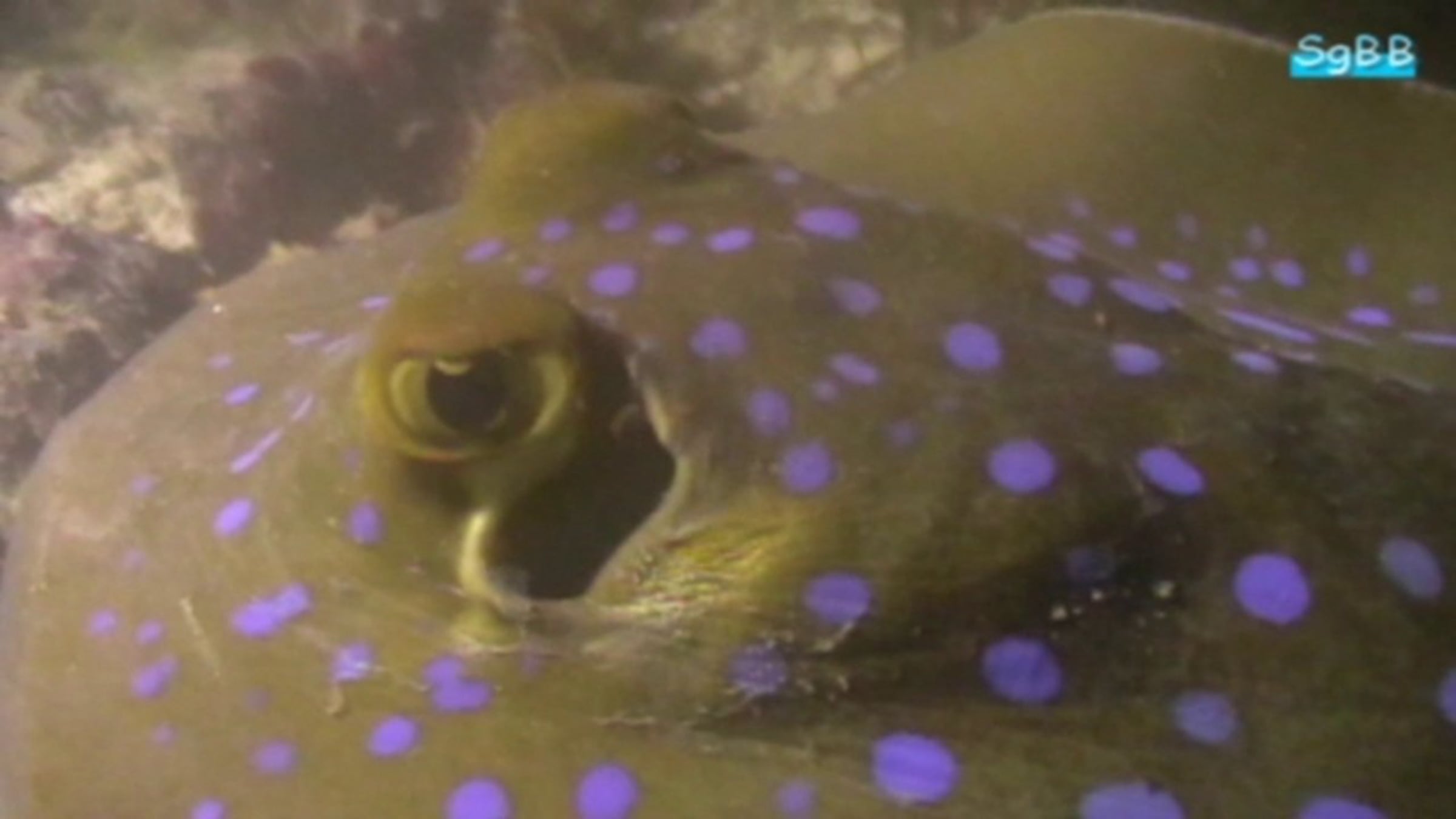
Sentosa Blue-Spotted Fantail Ray

Came across this very small blue spotted fantail ray on Sentosa. It was swimming in the shallows probably looking for food like small shrimp or bottom dwelling fish. The disc was slightly bigger than my palm. This seems to be a first record for Sentosa's Tj Rimau reef although it is frequently seen on our other Southern islands.
As with most marine ecosystems and organisms in Singapore waters, conservation should be a key concern for all Singaporeans. Amazing Singapore!. In which other capital city can you get to see such wildlife?
-----------------------------------------------------------------
More info from Wildsingapore:
wildsingapore.com/wildfacts/vertebrates/fish/dasyatidae/lymma.htm
Blue-spotted fantail ray
Taeniura lymma
Family Dasyatidae
Where seen? This beautiful stingray is sometimes encountered on sandy areas and in coral rubble near coral reefs on some of our shores. It is often also seen by divers. Sadly, it is also sometimes encountered trapped in a drift net.
Features: Grows to about 30cm in diameter, those seen about 20cm. Body oval with a rounded snout. Body colour brown, grey, yellow, olive-green to reddish brown; with lots of obvious bright blue spots. Eyes sticking out of the flat body, with large spiracles behind the eyes. Tail long rather thick with two blue stripes along the length. There is a broad skin fold under the tail, so it is sometimes called the Blue-spotted ribbontail ray. Like other rays, it has one or two venomous spines near the middle of the tail. The spines are used to protect itself and not to capture prey.
What does it eat? The ray moves into shallow sandy areas with the rising tide to forage for snails and clams, worms, shrimps and crabs. As the tide falls, it shelters in caves and under ledges. It is rarely found buried under sand. It is more active at night.
Fantail ray babies: The ray gives birth to live young.
Human uses: This stingray is harvested commercially as seafood. It is also considered an important gamefish for recreational fishermen. Small specimens are also taken for the aquarium trade, although they don't do well in captivity.
Status and threats: Throughout its range, the Blue-spotted fantail ray is under pressure from over collection for the aquarium trade and destruction of its reef habitat. It is considered near threatened.
Get started for free
24/7 customer support
Our customer support team is available to help 24/7. Enterprise members also receive dedicated account managers and a guaranteed uptime SLA.
© 2026 Vimeo.com, Inc. All rights reserved.
TermsPrivacyYour Privacy ChoicesU.S State PrivacyCopyrightCookies