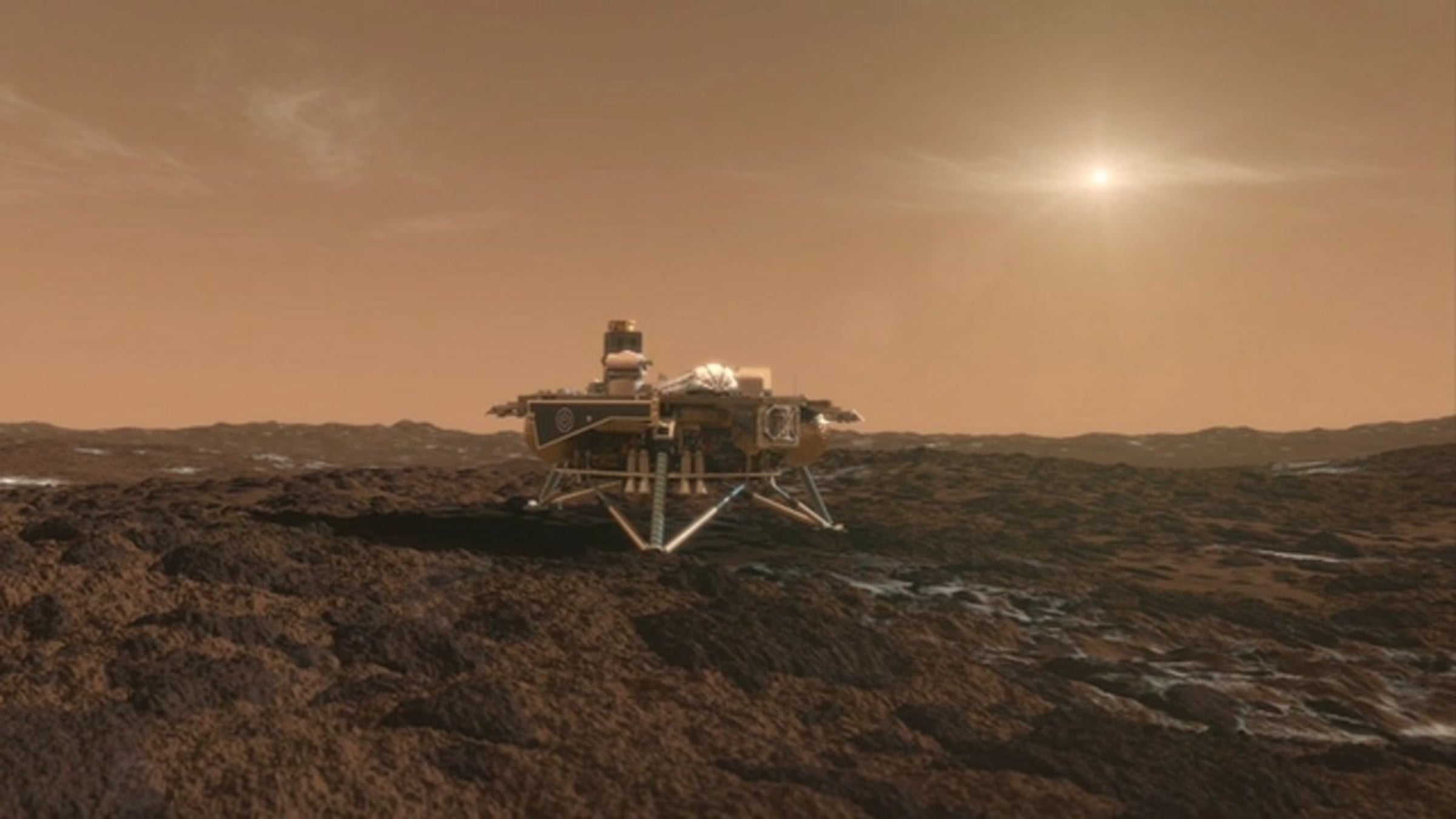
Phoenix - A Tribute

Español:
Phoenix o Phoenix Mars Lander es una sonda espacial construida por la NASA, lanzada el 4 de agosto de 2007 desde la base de Cabo Cañaveral con destino al planeta Marte. Su llegada se produjo a las 23:54 GMT del 25 de mayo de 2008 y la misión fue extendida hasta el 10 de noviembre de 2008.
El programa científico es un esfuerzo conjunto entre universidades de los Estados Unidos, Canadá, Suiza, Dinamarca y Alemania. Su objetivo primario fue llegar a una región cercana al Polo Norte marciano, desplegar su brazo robótico y hacer prospecciones a diferentes profundidades para examinar el subsuelo.
El lanzamiento se produjo el 4 de agosto de 2007 en un cohete Delta 7925, desde Cabo Cañaveral. La sonda sólo tuvo que hacer una corrección de trayectoria el 10 de agosto para ponerse rumbo a Marte. Su llegada a Marte se produjo a las 23:54 GMT del 25 de mayo de 2008.
La misión tiene varios objetivos:
* Determinar si hubo o pudo haber vida en Marte.
* Caracterizar el clima de Marte.
* Estudio de la geología de Marte.
* Efectuar estudios de la historia geológica del agua, factor clave para descifrar el pasado de los cambios climáticos del planeta.
La misión principal debería durar 90 días marcianos, unos 92 días terrestres aproximadamente. Tras el descubrimiento de hielo de agua, se decidió prolongar la misión cinco semanas más, para acabar finalmente el 10 de noviembre de 2008.
El fin de la misión en noviembre 10 de 2008, marcó el inicio de la interpretación detallada de los datos obtenidos. Sin embargo, algunos de los datos iniciales que fueron sobresalientes. El 19 de junio de 2008 la NASA afirmó que la sonda Phoenix encontró hielo al realizar una excavación cerca del Polo Norte de Marte. Unos trozos de material sublimaron después de ser descubiertos el 15 de junio por un brazo de robot.
Posteriormente se determinó que el suelo marciano —al menos dónde aterrizó la sonda— es alcalino, con un pH de entre 8 y 9 y análogo al suelo de la superficie cercana en los valles de la Antártida.
El 31 de julio, TEGA transmitió los resultados de una muestra de suelo que al principio había tenido problemas para introducir en su horno, debido a que gran parte de ella se adhería a la pala del brazo robótico. Según estos resultados, su contenido era hielo de agua, con lo cual, quedó directamente confirmada su presencia en Marte.
El 30 de septiembre, Phoenix detectó nieve en la atmósfera de Marte, una observación sin precedentes. Un instrumento láser concebido para analizar las interacciones entre la atmósfera y la superficie del suelo marciano, detectó nieve proveniente de nubes a 4,000 metros de altitud sobre Phoenix. Según las observaciones, los copos de nieve se sublimaron antes de llegar a la superficie de Marte.
Experimentos realizados con los instrumentos de Phoenix, también revelaron rastros de reacciones químicas entre minerales del suelo marciano y agua líquida en el pasado. Esto indica momentos en el pasado de Marte en los cuales corría agua líquida por el suelo. Los datos generados por la sonda Phoenix también sugieren la presencia de carbonato de calcio, el principal componente de la roca caliza. La mayoría de los carbonatos y arcillas sobre la Tierra se forman con la presencia de agua líquida.
El 29 de octubre de 2008, se perdió el contacto con Phoenix para ser recuperado al día siguiente con la ayuda de la sonda orbital Mars Odyssey. Al parecer, la sonda entró en "modo seguro" o "hibernación" debido a la disminución de la luz solar conforme avanza el invierno en Marte. La sonda fue reactivada pero la poca energía solar disponible obligó a la desconexión de la mayoría de los calentadores necesarios para la función de los sistemas mecánicos y electrónicos, así como suspender todas las operaciones científicas, a excepción del monitoreo climatológico. En días posteriores, se consiguió establecer contacto a diario con Phoenix, pero sólo durante breves períodos de tiempo al amanecer.Finalmente se decidió dar la misión por finalizada al no recibirse señales de ella, como era esperado con el avance del invierno.
English:
Phoenix was a robotic spacecraft on a space exploration mission on Mars under the Mars Scout Program. Mission scientists used instruments aboard the Phoenix lander to search for environments suitable for microbial life on Mars, and to research the history of water there.
The multi-agency program was headed by the Lunar and Planetary Laboratory at the University of Arizona, under the direction of NASA's Jet Propulsion Laboratory. The program was a partnership of universities in the United States, Canada, Switzerland, Denmark, Germany, the United Kingdom, NASA, the Canadian Space Agency, the Finnish Meteorological Institute, Lockheed Martin Space Systems, MacDonald Dettwiler & Associates (MDA) and other aerospace companies. The operational funding for the mission extended through November 10, 2008.
Phoenix is NASA's sixth successful landing on Mars out of the twelve attempts that reached Mars. It is the most recent spacecraft to land successfully on Mars. It is also the first successful landing on a polar region of Mars. The mission was declared concluded on November 10, 2008, after engineers were unable to contact the craft. The lander last made a brief communication with Earth on November 2.
The mission had two goals. One was to study the geologic history of water, the key to unlocking the story of past climate change. The second was evaluate past or potential planetary habitability in the ice-soil boundary. Phoenix's instruments were suitable for uncovering information on the geological and possibly biological history of the Martian Arctic. Phoenix was the first mission to return data from either of the poles, and contributed to NASA's main strategy for Mars exploration, "Follow the water."
The primary mission was anticipated to last 90 sols (Martian days) – just over 92 Earth days. However, the craft exceeded its expected operational lifetime by a little over two months before succumbing to the increasing cold and dark of an advancing Martian winter. Researchers had hoped that the lander would survive into the Martian winter so that it could witness polar ice developing at the spacecraft's exploration area. As much as three feet of solid carbon dioxide ice could appear in the area. Even if the lander had survived part way into the winter, it was very unlikely that it would have functioned throughout the entire winter due to the intense cold. The mission was chosen to be a fixed lander rather than a rover because:
1. costs were reduced through reuse of earlier equipment;
2. the area of Mars where Phoenix is landing is thought to be relatively uniform and thus traveling is of less value; and
3. the equipment weight that would be required to allow Phoenix to travel can instead be dedicated to more and better scientific instruments.
The 2003–2004 observations of methane gas on Mars were made remotely by three teams working with separate data. If the methane is truly present in the atmosphere of Mars, then something must be producing it on the planet now, because the gas is broken down by sunlight within 300 years, therefore the importance to search for biological potential or habitability of the Martian arctic's soils. Methane could also be the product of a geochemical process or the result of volcanic or hydrothermal activity. Other future missions may enable us to discover whether life does indeed exist on Mars today.
The robotic arm's first movement was delayed by one day when, on May 27, 2008, commands from Earth were not relayed to the Phoenix lander on Mars. The commands went to NASA's Mars Reconnaissance Orbiter as planned, but the orbiter's Electra UHF radio system for relaying commands to Phoenix temporarily shut off. Without new commands, the lander instead carried out a set of activity commands sent May 26 as a backup. On May 27 the Mars Reconnaissance Orbiter relayed images and other information from those activities back to Earth.
The robotic arm was a critical part of the Phoenix Mars mission. On May 28, scientists leading the mission, sent commands to unstow its robotic arm and take more images of its landing site. The images revealed that the spacecraft landed where it had access to digging down a polygon across the trough and digging into its the center.
The polygonal cracking in this area had previously been observed from orbit, and is similar to patterns seen in permafrost areas in polar and high altitude regions of Earth. A likely formation mechanism is that permafrost ice contracts when the temperature decreases, creating a polygonal pattern of cracks, which are then filled by loose soil falling in from above. When the temperature increases and the ice expands back to its former volume, it thus cannot assume its former shape, but is forced to buckle upwards. (On Earth, liquid water would probably enter at times along with soil, creating additional disruption due to ice wedging when the contents of the cracks freeze.)
The Lander's Robotic Arm touched soil on the red planet for the first time on May 31, 2008. It scooped dirt and started sampling the Martian soil for ice after days of testing. Phoenix's Robotic Arm Camera took an image underneath the lander on sol 5 that shows patches of a smooth bright surface uncovered when thruster exhaust blew off overlying loose soil. It was later shown to be ice. Ray Arvidson of Washington University in St. Louis said: "We could very well be seeing rock, or we could be seeing exposed ice in the retrorocket blast zone."
Get started for free
24/7 customer support
Our customer support team is available to help 24/7. Enterprise members also receive dedicated account managers and a guaranteed uptime SLA.
© 2026 Vimeo.com, Inc. All rights reserved.
TermsPrivacyYour Privacy ChoicesU.S State PrivacyCopyrightCookies