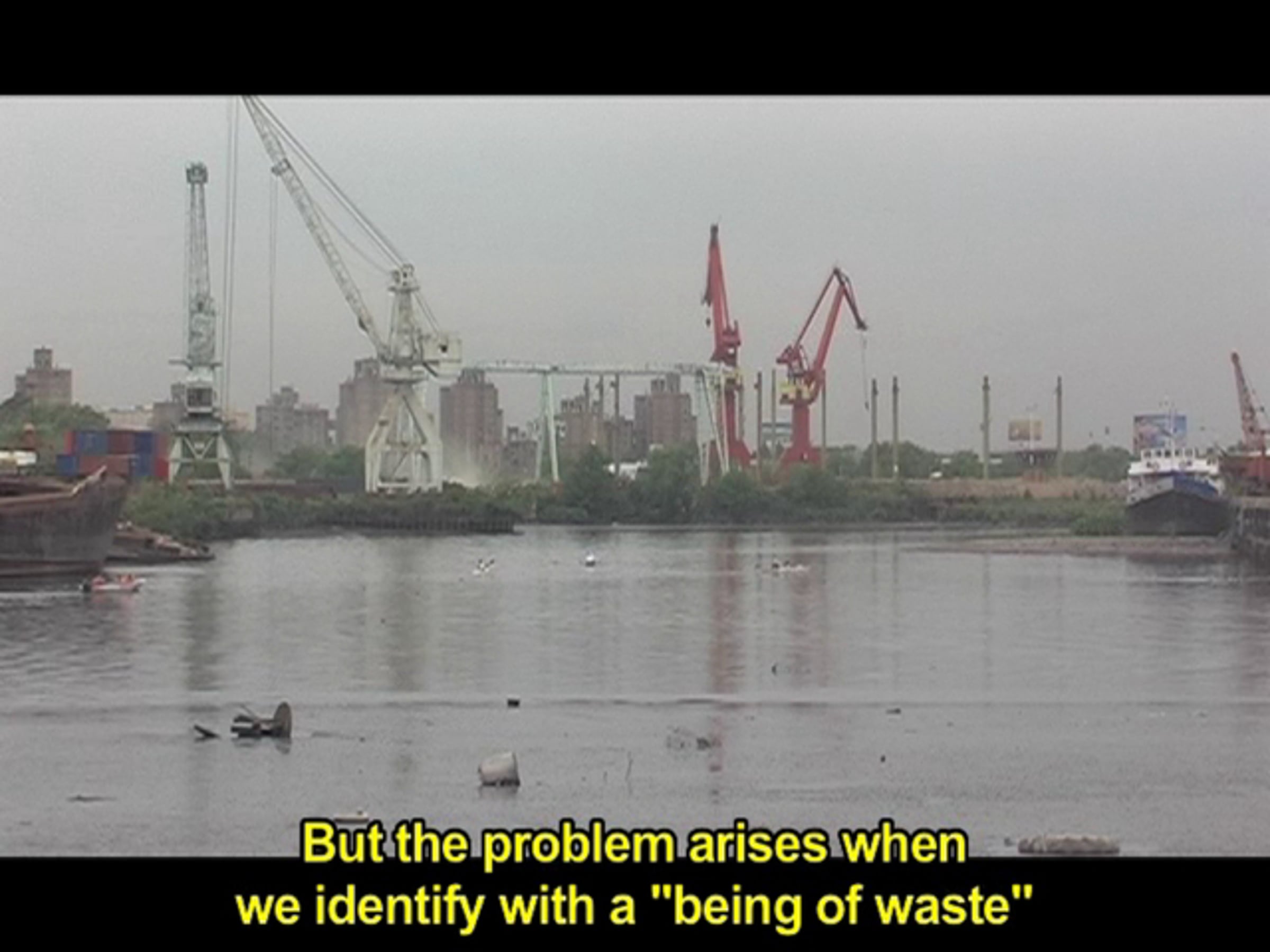
STAGING CITIES/CIUDADES EN ESCENA. Una asamblea de humanos y no humanos en la cuenca del Matanzas-Riachuelo

STAGING CITIES.
Poniendo ciudades en escena: Buenos Aires 2009.
m7red
Entes, cosas, infraestructuras, personas, maquinas, grupos, instituciones, personajes, como conviven? Cómo están pobladas la ciudades? Que conflictos los unen y los separan?
Staging cities/Ciudades en escena se plantea el problema de la puesta en escena de la ciudad, de la puesta en público de seres o entidades y de su convivencia.
Poner en público esta diversidad es una apuesta política.
Los parlamentos son un escenario donde las ciudades se pueden ver a si mismas. Pero los parlamentos son un tipo particular de puesta en escena de lo público.
Staging cities/Ciudades en escena plantea el desafío de la construcción colectiva de personajes y escenarios urbanos como un nuevo dispositivo escénico-político.
Staging cities/Ciudades en escena comenzó en el año 2006 como un experimento de discusión urbana que conectaba las ciudades de Ámsterdam y Buenos Aires en un juego de rol en tiempo real a través de Internet.
El escenario construido para Buenos Aires hipotetizaba un enfrentamiento de clases sociales en Puerto Madero, el proceso de urbanización mas reciente y caro de la ciudad. El que emergió en Ámsterdam puso en escena el conflicto entre la comunidad local y la minoría musulmana, como una continuación de los disturbios raciales que tuvieron lugar en Francia durante el año 2005.
En el año 2007 se monto un proceso de discusión de 8 meses en la ciudad de Porto Alegre como parte de la 6ta. Bienal del Mercosul.
El escenario que emergió esta vez fue el centro de la ciudad de Porto Alegre: la ocupación por el comercio informal y el vaciamiento habitacional. Se monto una sala para dar lugar a las representaciones. El dispositivo constaba de unas cabinas de entrenamiento actoral para ciudadanos, y una sala de discusiones mediante computadoras en red.
A partir de esta experiencia, el Instituto de Arquitectos de Brasil de Rio Grande do Sul encargo la planificación de un programa de investigación y el diseño de una sala del “Teatro del Chat” para explorar el futuro urbano de Porto Alegre.
Pero el trabajo con escenarios sociales y personajes humanos se volvió insuficiente para entender la creciente complejidad del fenómeno de urbanización. Esto se hizo visible al comenzar la construcción de un nuevo escenario para la ciudad de Buenos Aires: el de la cuenca del Riachuelo Matanzas.
Desde los tiempos del virreinato, el “riachuelo” es mas un campo de batalla ecológico y político mas que un ecosistema armónico. Las cuestiones ecológicas que se plantean en este escenario aparecen como controversias e incertidumbres entre actores de muy diversa especie. Aguas negras, poblaciones precarias, agencias gubernamentales, industrias contaminantes, técnicos, residuos, etc. Pero podemos considerar a un ecosistema como una suerte de asamblea sin paredes, dentro de la cual muchos tipos de estos “locutores” pueden “tener una voz”…
Entonces, cómo hacer un teatro urbano en donde tanto humanos como no humanos tengan voz en esta controversia pública?
Se diseño un dispositivo escénico compuesto por una mesa con 6 expertos de diversas áreas y una “voz” artificial que los interpelaba. El objetivo del dispositivo era hacer aparecer y dar voz, colectivamente, a un actor privilegiado en este escenario: la "mierda urbana" de la cuenca. Esta es la primer experiencia registrada con este dispositivo con miras a una futura representación ampliada de este escenario.
STAGING CITIES/CIUDADES EN ESCENA
BUENOS AIRES
Producción, concepto y dirección: M7red. Mauricio Corbalan, Pio Torroja.
Cámara y edición: Julian D`angiolillo
Cámara: Julia Masvernat.
Equipo de producción: Paola Salaberri, Martin Dipeco, Noelia Leonzio.
Sonido: Pablo Chimenti, Hernan Kerllenevich
Agradecimientos: Museo de Bellas Artes de La Boca Benito Quinquela Martín, Museo Histórico Hospital Bernardino Rivadavia,Fundación por La Boca, agrupación musical “Los hijos de Zas”.
Proyecto hospedado por Het Blauwe Huis, Ijburg, The Netherlands.
Con el apoyo del CCBA Centro Cultural de España en Buenos Aires
(ENG)
STAGING CITIES: AN ASSEMBLY OF HUMANS AND NOT HUMANS AT THE RIACHUELO RIVER BASIN.
Staging cities experiments with new ways of staging public issues.
How cities are populated?
Entities, things, infrastructures, people, machines,groups, institutions, characters... How they live together? Which are the conflicts that gather and separate them?
“Staging Cities/Ciudades en escena” takes the problem of staging the city, its systems, beings, entities and their conflictive coexistence.
To stage this diversity is a political bet in itself.
Parliaments are the usual stage where sometimes cities and citizens can look at themselves. But parliaments are just one way of many to stage public issues.
The challenge at Buenos Aires is to set up a new assembly device to give voice to emergent characters in order to expand political imagination.
Staging Cities set up the challenge of consider a collective building technique of characters and scenarios as a new political scenic device.
Staging cities began in the year 2006 at Het Blauwe Huis, as an experiment of urban discussion which connected the cities of Ijburg/Amsterdam and Buenos Aires in a role play game in real time using instant messaging systems on internet.
The scenario built up for Buenos Aires fictionalized a clash between the underclass and the governmental board and brokers that manage Puerto Madero, a new urbanized area, which is the most exclusive and expensive of the city center.
The scenario that emerged in Amsterdam staged the conflict between the local community and the Muslim immigrants as a continuation of the racial disturbs which happened in France during 2005.
In the year 2007 a discussion process was held during eight months at the city of Porto Alegre, Brazil, as part of the Mercosul Art Biennale.
The scenario which emerged this time was the central area of the city of Porto Alegre.
The occupation of the city center by illegal traders and the subsequent abandonment and decay of the dwellings located at the area.
An special “assembly hall” was made at the biennale to stage the sessions. The device was composed of “video-cabins” for actoral training of citizens and a “debate room” with a screen and a table displaying 8 computers connected between them.
From that experience, the Institute of Architects of Brazil of Rio Grande do Sul, commissioned m7 to deliver a research program and the design of a specific room for the “Teatro do chat” at their headquarters located in the central area of the city. This device is intended to foster the debate and to explore the alternative futures for the city of Porto Alegre
But the work focused on local scenarios and human characters became insufficient to understand the growing complexity of the urbanization phenomena. This was made visible at the beginning of the setting up of the new scenario for the city of Buenos Aires: the Matanzas-Riachuelo river basin.
From Spanish colonial times, the Riachuelo is more an ecological and political battlefield than an harmonic ecosystem. The ecological issues that are set up in this scenario appear as controversies and uncertainties between actors of very different type. Black waters, precarious settlements, governmental agencies, polluting industries, technicians, waste, etc.
We can call an ecosystem as an “assembly without walls”, where many actors can have a “voice”.
How to make an urban theater where humans and not humans can have a voice in this public controversy?
An scenic device was designed to develop this scenario. It was composed by a table with six experts from diverse areas and an “artificial voice” with a script which interrogated them. The goal of the device was to make appear and give voice collectively, to the main non-human actor of this scenario: the “urban shit”of the basin.
This was the first experience registered with this device and we are looking further to future sessions with other actors in order to expand the scenario.
“Staging Cities: The urban shit of the Matanzas-Riachuelo river basin. Buenos Aires 2009.”
video.14 min.
Concept, production and direction: M7red. Mauricio Corbalan, Pio Torroja.
Camera and editing: Julian d`Angiolillo
Additional camera: Julia Masvernat.
Production team: Paola Salaberri, Martin Dipeco, Noelia Leonzio.
Sound: Pablo Chimenti, Hernan Kerllenevich
Acknowledgements: Museo de Bellas Artes de La Boca Benito Quinquela Martín, Museo Histórico Hospital Bernardino Rivadavia, Fundación por La Boca, agrupación
musical “Los hijos de Zas”.
Project hosted by Het Blauwe Huis, Ijburg, The Netherlands.
With the support of CCEBA. Centro Cultural de Espana en Buenos Aires.
Get started for free
24/7 customer support
Our customer support team is available to help 24/7. Enterprise members also receive dedicated account managers and a guaranteed uptime SLA.
© 2026 Vimeo.com, Inc. All rights reserved.
TermsPrivacyYour Privacy ChoicesU.S State PrivacyCopyrightCookies