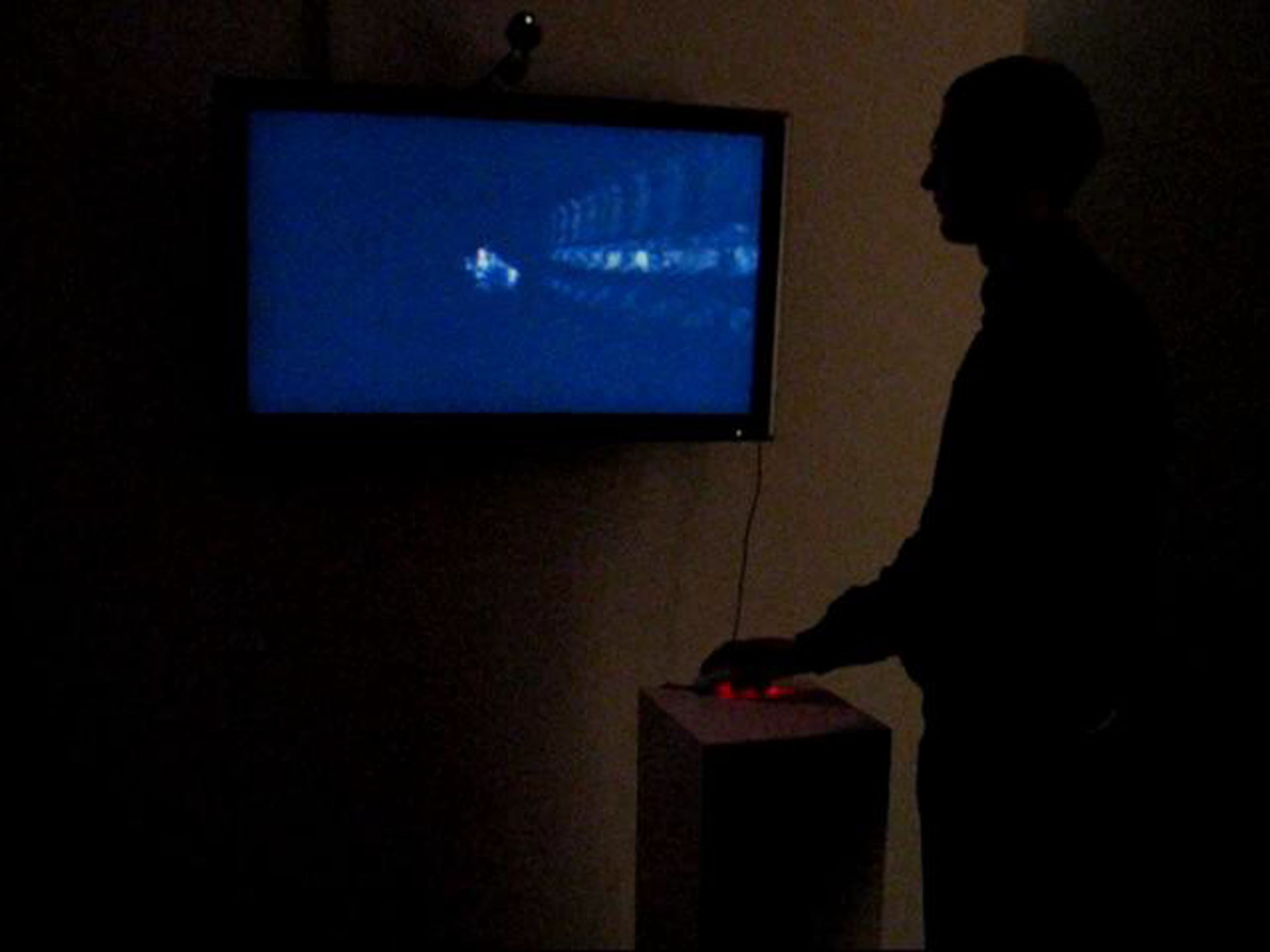
time and motion study - installation documentation UTS gallery

time and motion study
John Tonkin
In the late 1800’s scientist/inventors such as Marey and Muybridge developed a number of pre-cinematic devices to analyse motion. These technologies allowed people to observe time and space in a way beyond normal human capabilities, creating a heightened sense of awareness of our passage through time. The images that were produced captured the public imagination and influenced artists such as Duchamp (“Nude Descending a Staircase”, 1912) and Balla (“Dynamism of a Dog on a Leash”, 1912).
Later technologies such as strobe photography and video effects processing have continued these explorations leading to the production of images such as “.30 Bullet Piercing an Apple” (1964) by Harold Edgerton and music videos such as Amii Stewart’s “Knock on Wood” and the Jackson 5’s “Blame it on the Boogie”.
time and motion study uses contemporary technology to further investigate time and motion. The users’ image in front of a camera is captured as a sequence of frames positioned along a timeline in three dimensional space. Only those parts of the image that are moving are rendered visible. The user is able to zoom in and out and to navigate forward and backwards through time. They are able to view sequences from any point in time during the course of the entire exhibition. Like many of my recent projects the work is formed through the accumulated actions of its users.
The playful gestures of the audience build an archive of animated self portraits, like the pages of a flip book, a series of ghostly fragments echoing through time.
.
Get started for free
24/7 customer support
Our customer support team is available to help 24/7. Enterprise members also receive dedicated account managers and a guaranteed uptime SLA.
© 2026 Vimeo.com, Inc. All rights reserved.
TermsPrivacyYour Privacy ChoicesU.S State PrivacyCopyrightCookies