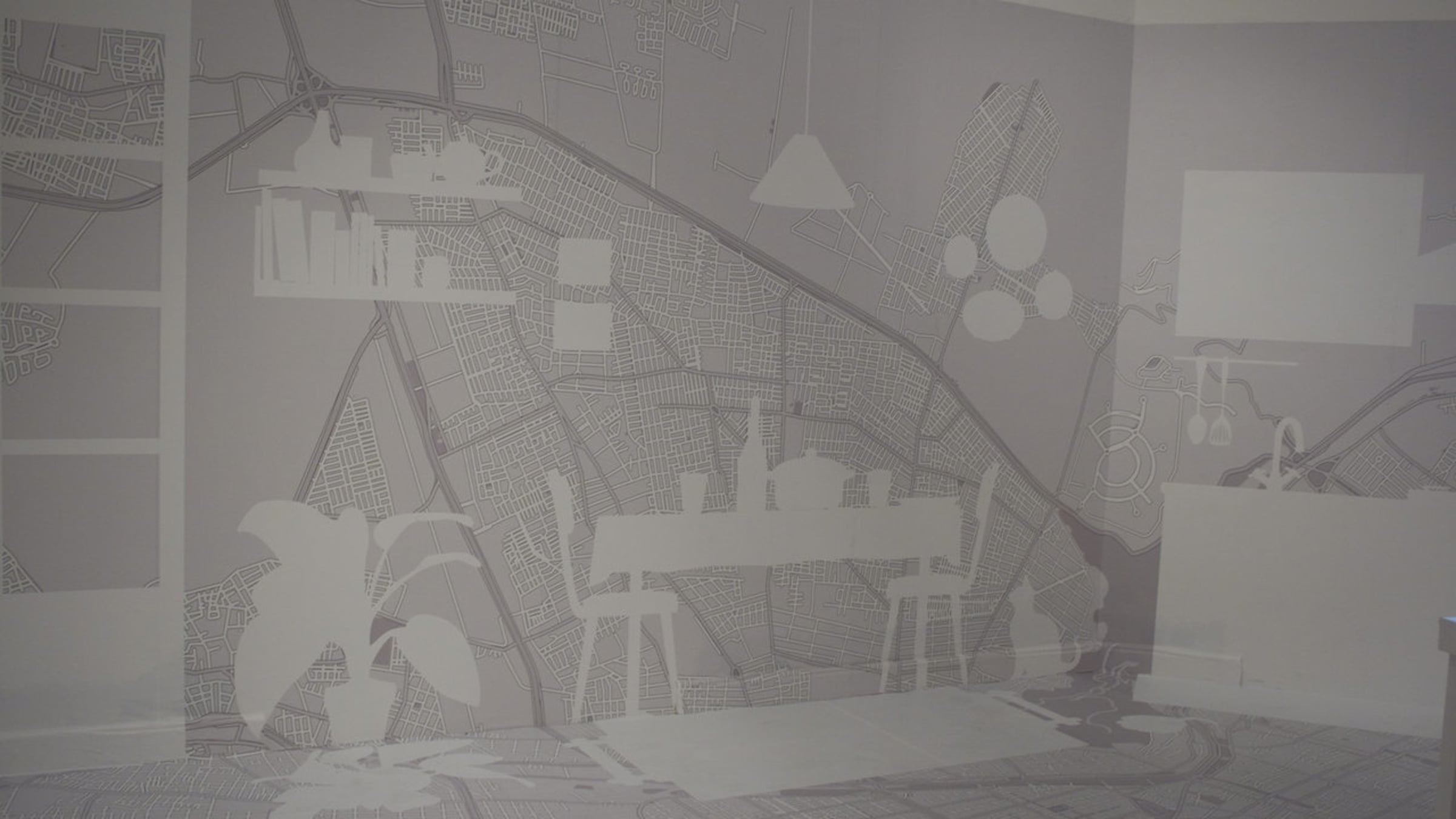
TRANSITOS_Site specific installation

Transitos is a site specific installation created for the Contemporary Art Museum of Santiago de Chile and develops a thematic closely linked to the relationship man-home-territory. The concept of transit migration, transition, the need of the appropriation, the feeling of belonging to a community and the defamiliarization that follows to a deplacement are the foundations of the entire project.
A city map envelops the walls and floor the urban texture as an abstract and geometric wallpaper.
The exhibition space becames a house, house percepibile through "missing" objects, furnitures which leave traces as on a wallpaper where they have been for a long time; the shapes on the walls are the only witnesses of what lived there.
The silhouettes of the furniture are gaps, white shadows that cut paths, that clear directions and confuse destinations.
The only real object inside is a table on wich is projected a video. In the video flow images of landscapes, streets, places, and portraits of people; a hand with a pen try to delineate the contours, to reproduce the silhouettes, to study the shapes. The images move slowly, forcing the hand to restart, to draw again the lines, to split that vision that we believed to have stopped or that we believed to be able to fix.
----------------------------------------------------------------------
Il percorso artistico di Claudia Gambadoro è una relazione ossimorica con il perduto e la memoria, con l’orientamento e lo spaesamento, con il legame e il distacco, un attraversamento di permanenza e impermanenza, centro e distanza, costruzione e destrutturazione, saturazione e sottrazione, di nomadismi interiori e di chi si sradica senza scelta. Di geometrie del caos. Un farsi nomade, straniera, apolide ovunque, senza mai ritorni, perennemente errante.
Transitos, un lavoro complesso, pensato site specific per il Museo di Arte Contemporanea di Santiago del Cile dopo un’esperienza di residenza, è strutturato per sottrazioni, per assenze. È la condensazione di un microcosmo. È una dialettica di contenitore e contenuto, farsi spazio dentro un altro spazio. L’invenzione di un esperanto.
La mappa di Santiago diviene una scatola della memoria, un territorio in cui si arriva da estranei, un luogo di non ritorno. Vi abita lo smarrirsi e la necessità dolorosa di una terra in cui trovarsi.
(dal testo in catalogo di Simonetta Angelini)
Get started for free
24/7 customer support
Our customer support team is available to help 24/7. Enterprise members also receive dedicated account managers and a guaranteed uptime SLA.
© 2026 Vimeo.com, Inc. All rights reserved.
TermsPrivacyYour Privacy ChoicesU.S State PrivacyCopyrightCookies