Deruralization of the Niger Delta: Reconsidering Rurality in the Urbanization Discourse

A videographic essay by Sourav Biswas, Yujun Yin, and Sara Zewde.
This video is produced for the 'DES 3241 : Theories of Urbanism, Landscape, Ecology', a course taught by Pierre Bélanger at Harvard University Graduate School of Design in the Fall 2013.
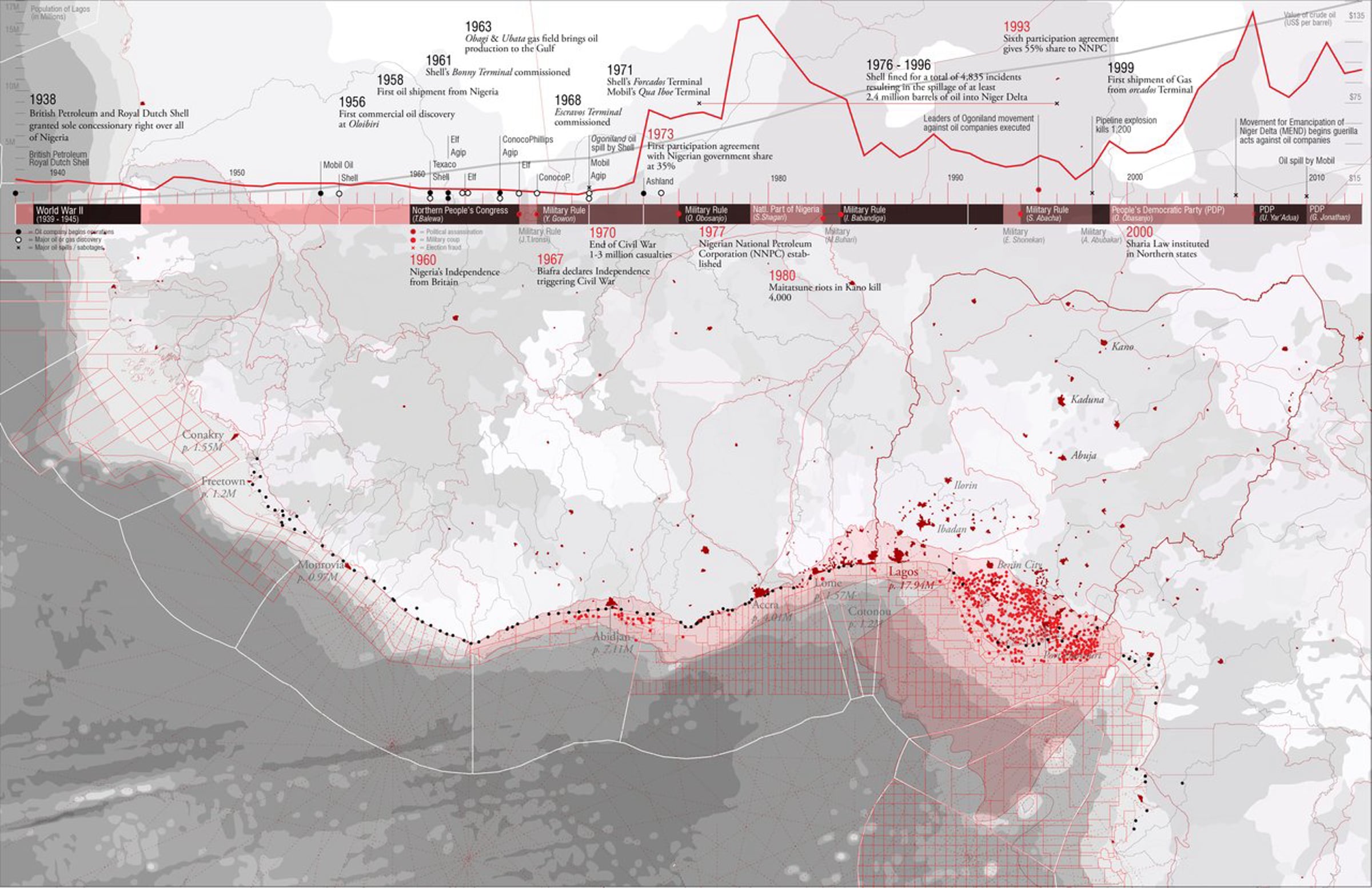
The West African coast is home to a network of growing, dynamic urban centers. And while urbanists remain fascinated by the peculiarities of hyper-growth and informal settlement, analyses of concurrent processes of de-ruralization have been missed. By framing the changing lagoonal landscapes of the West African coast solely as a process of urbanism, we fail to understand the conditions of de-ruralizing landscapes as integral to conditions of urban settlement. Perhaps none of these cities has prompted more discussion in urban discourse as Lagos, Nigeria, one of the fastest growing cities in the world. In view of Vikramāditya Prakāsh’s
notion of de-ruralization, the Lagosian context offers an opportunity to re-consider ruralism, and the violent transformation of rural landscapes, as a core condition of what is happening to cities.
As a slave port city, post-colonial capital, and now, emergent financial center of an economy fueled by extractive industries, Lagos shares similar trajectories as the lagoonal urbanisms of the West African coast, including Abidjan, Accra, and Lome. The late 1950s saw the discovery of oil in the estuarine and offshore region of the Niger Delta, prompting petroleum to become the most important Nigerian industry, now accounts for 90% of gross revenues.
However, years of political turbulence, unaccountable institutional and corporatist practices, and structural failures has disconnected the larger population from the benefits of oil wealth. Processes of extraction have led to enormous environmental and social damage, uprooting agrarian livelihoods with little of the generated wealth helping to improve the region. Mangrove swamps, rivers, and wildlife that supported the fishing practices and survival of local communities have been badly affected by repeated oil spills. To gain access to hydrocarbon bearing zones, oil & gas development companies carry out dredging in order to overcome the network of creeks and river systems of the delta. Waterway sediment, soil, creek banks and vegetation are typically removed and deposited as dredge spoils at the bank of the newly dredged canals. Uncapped and unconfined, leachates from the dredging material often return to the water body. Gas flaring, the burning of the gas released when crude oil is pumped up from the ground, causes damage to agriculture due to acid rain and also causes a wide range of health effects. Ethnic and political unrest in the Niger Delta arose in the early 1990s and continues, as groups aim to expose the devastation of the region and secure a greater share of the oil revenues. The actions of some groups include sabotage of oil development infrastructure, theft of oil, property destruction, guerilla warfare, kidnapping, and pirating. In May of 2009, the Nigerian military began offensives against groups such as the Movement for the Emancipation of the Niger Delta, which have caused hundreds of deaths and thousands to flee their homes
Prakāsh’s assertion on the deruralizing landscape provides a valuable lens for understanding West Africa’s lagoonal urbanisms. As Lagos maintains its position as the financial headquarters of the country’s extractive industries, we see that it is a transformation of rurality that is in fact critical to its growth, similar to many West African cities. Destructive resource extraction, and associated resource and migration flows, must be acknowledged in our understandings of urbanization.
Get started for free
24/7 customer support
Our customer support team is available to help 24/7. Enterprise members also receive dedicated account managers and a guaranteed uptime SLA.
© 2026 Vimeo.com, Inc. All rights reserved.
TermsPrivacyYour Privacy ChoicesU.S State PrivacyCopyrightCookies