Lutyens: String Trio, Op 57, ii (1964)

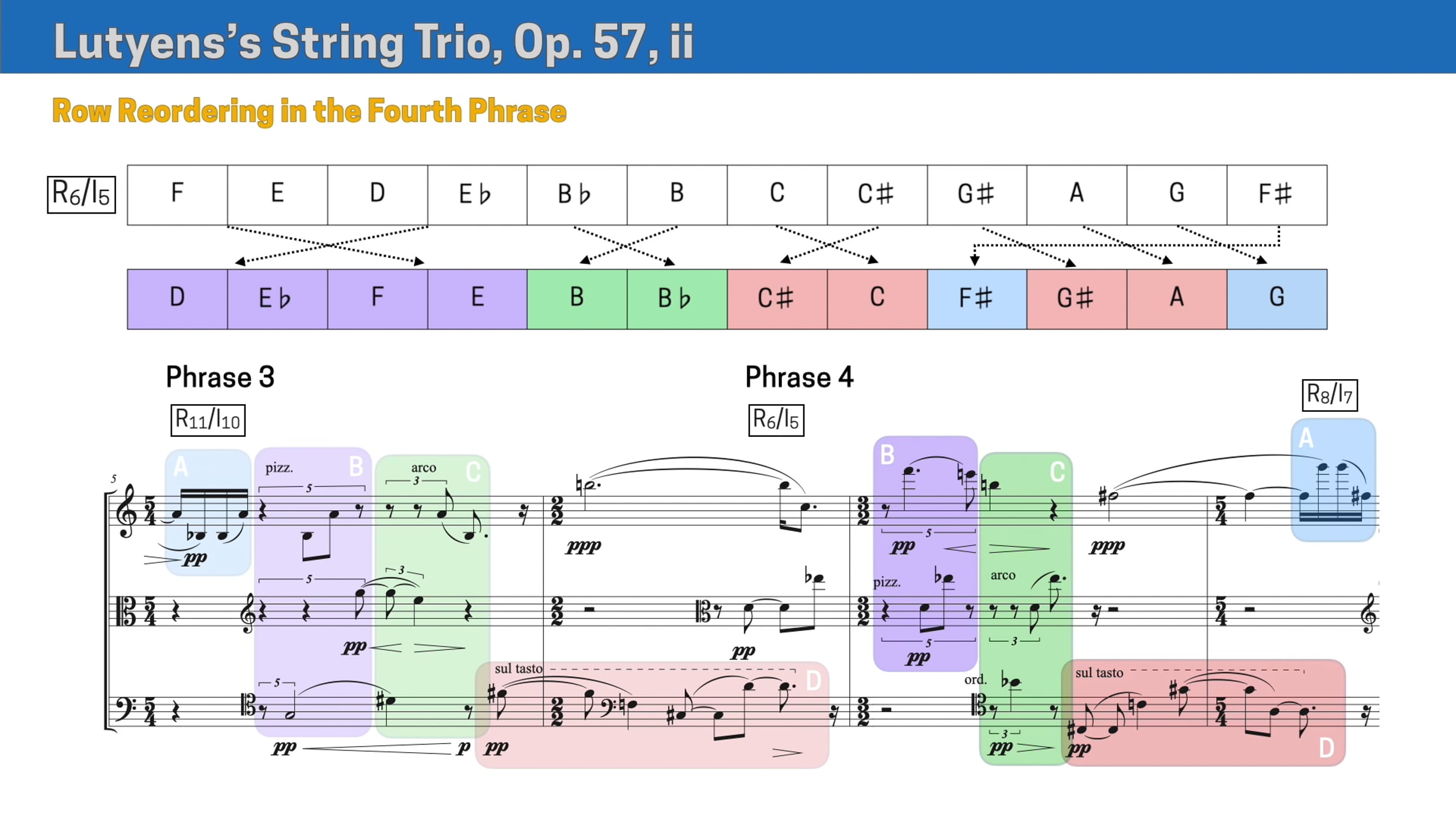
The second movement of Elisabeth Lutyens String Trio, Op. 57 (1964) showcases her characteristic compositional approach, in which serial techniques are employed in the service of a rich gestural style. The musical surface of this movement is almost entirely saturated by interval-class 1 (ic1), issuing from a twelve-tone row that comprises two hexachords with set class (012367), related by I11. This row can also be segmented as three (0123) tetrachords, each containing two ic1 dyads. For most of the piece, Lutyens treats these tetrachords as unordered collections of pitches, preserving only the ic1 relationship within each dyad. Beyond pitch organization, Lutyens also introduces cyclical structures in meter and gesture. The movement cycles continuously through the time signatures 3/2, 5/4, and 2/2, while four distinct gestural ideas––defined by articulation, rhythm, and interval content––unfold in a fixed sequence. This video illustrates how Lutyens employs serial techniques to generate pitch material with specific intervallic characteristics, while freely adapting this material to align with the broader gestural trajectories that animate the work.
Authored and Recorded by Nathan Cobb, Adjunct Assistant Professor of Music Theory at Shenandoah University
Get started for free
24/7 customer support
Our customer support team is available to help 24/7. Enterprise members also receive dedicated account managers and a guaranteed uptime SLA.
© 2026 Vimeo.com, Inc. All rights reserved.
TermsPrivacyYour Privacy ChoicesU.S State PrivacyCopyrightCookies