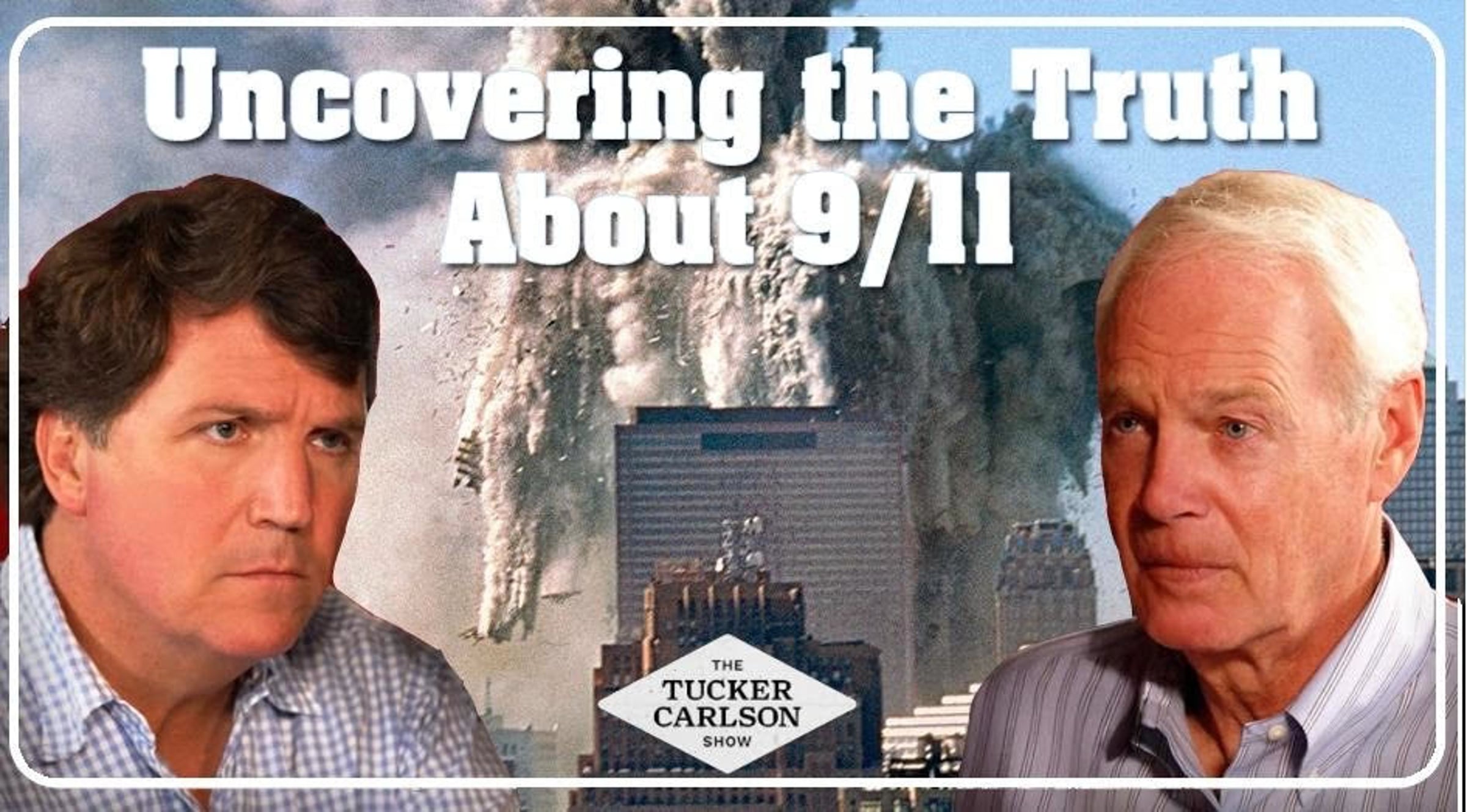
Tucker Carlson Taking on 9/11 Truth with Senator Ron Johnson - 18 min Segment

We’re making significant progress now! That cannot be denied.
We have a sitting Senator drawing attention (as the Chairman of Homeland Security, the Chair of the Senate Permanent Subcommittee on Investigations, and the Chairman of the Senate Oversight Committee) in today’s major interview with Tucker Carlson, to:
- 156 First Responder witnesses of explosions — many before the towers descended — omitted from the NIST report
- “…Molten Steel in the Twin Towers” — (seen pouring out of the South Tower just minutes before its collapse)
- “The ash [WTC Dust] contains residue of both burnt and unburnt [nano]thermite.”
- Building 7 as a clear Controlled Demolition — “the only way that happens is if you blow up all their supports at the same time.”
- “….iron spheres with extreme temperatures.”
- “It wouldn’t come down so symmetrically. You wouldn’t have a free fall.”
- Major witnesses of explosions such as “Barry Jennings”
- “It was literally predicted to come down.”
- “Alaskan structural engineering professor [Hulsey] does a four-year study on it that pretty well debunks the NIST analysis.”
- Truth of 9/11 was covered up by the 9/11 Commission… “set up to fail”
- “Nothing's adding up. I mean…structurally, just basic engineering, basic physics, it doesn't make sense.”
- “They are very effective at marginalizing and discrediting anybody who's asked the questions.”
- “The firefighters want to know [the truth about 9/11].”
- “You talk to guys like Richard Gage, the [former] head of Architects [& Engineers] for 9/11 Truth.”
I’m awfully glad that the senator asked me to sit down with him on a Zoom call and review all of the above evidence with him the day before this major interview!
And Tucker, for his part, admitted yet again, “Because I was part of the coverup and I feel guilty about it, that's why, and I'm trying to atone for my previous sins.”
Watch the entire 2-hour interview here:
https://youtu.be/hMk0orYKXQk?si=FxUn7z8ZalLSKAGW
Here’s a summary of the entire interview.
In this interview, Senator Ron Johnson discusses his inquiries into various controversial topics that many avoid. He questions the official narratives of 9/11, particularly why Building 7 collapsed in a manner like a controlled demolition, while not being hit by a plane. The senator highlights the baffling silence and lack of thorough investigations into such events, fueled by requests from 9/11 family members for transparency and answers. This has led him to ask unpopular questions that he believes deserve attention, a stance that has drawn criticism from some of his colleagues, such as Congressman Mike Lawler, who accused him of dishonoring the memory of 9/11 victims by promoting conspiracy theories.
Johnson also criticizes the federal government’s handling of COVID-19 vaccine injuries. He reveals that the Vaccine Adverse Event Reporting System (VAERS) has logged over 38,000 deaths globally due to the COVID vaccines, with a significant portion occurring soon after vaccination. Despite these concerning figures, Johnson notes the lack of accountability and continued suppression of data that might provide a clearer picture of the vaccines' risks. Instead of addressing these issues, the government and healthcare agencies have dismissed or ignored the legitimate suffering of vaccine-injured individuals.
Moving on to government spending, Johnson expresses alarm at the federal government’s rapidly escalating expenditures, particularly since the COVID-19 pandemic. He details how significant amounts of discretionary and mandatory spending, including so-called 'other mandatory' categories, contribute to the national debt, which has swelled to nearly $37 trillion. He criticizes the lack of awareness among his Congressional colleagues about the total federal spending and the failure to have a serious, open discussion about reducing it to pre-pandemic levels.
Johnson recounts his experience of trying to investigate debates and provide oversight on government spending. He describes instances where neither his colleagues nor the media could provide accurate figures on federal expenditures, highlighting a disturbing level of ignorance or indifference among those responsible for managing the nation's finances. Johnson argues for more rigorous scrutiny and a commitment to fiscal responsibility.
Similarly, he critiques the military-industrial complex and its role in perpetuating unnecessary and costly foreign interventions. He highlights that despite rapid increases in defense spending, the U.S. has not won a war in 80 years, questioning the efficiency and purpose of such expenditures. He suggests reassessing what the Department of Defense is achieving with these funds and advocates for better-targeted defense spending.
The interview touches on the broader issue of public health, particularly the role of the pharmaceutical industry. Johnson criticizes the dominance of heavily marketed pharmaceutical solutions that often fail to address the root causes of chronic
Get started for free
24/7 customer support
Our customer support team is available to help 24/7. Enterprise members also receive dedicated account managers and a guaranteed uptime SLA.
© 2026 Vimeo.com, Inc. All rights reserved.
TermsPrivacyYour Privacy ChoicesU.S State PrivacyCopyrightCookies