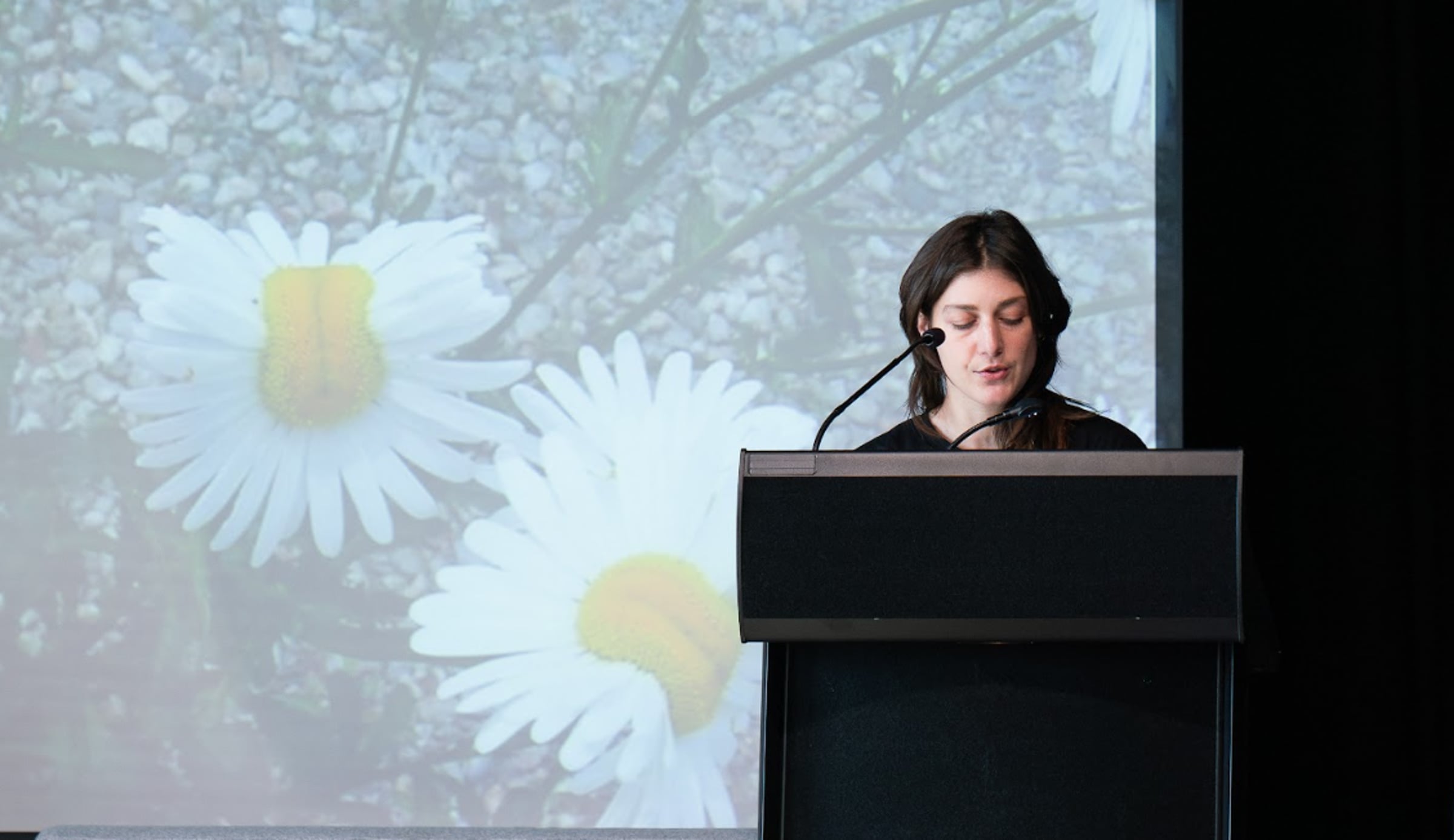
Rosie Isaac: Bathtub Analogy

Rosie Isaac’s work, as it often does, began with language. In this case, she developed a performance lecture to expand on her works Tip test and Total Dissolved Solids.
Suspended across the windows of West Space, looking out onto the rapidly gentrifying suburb of Collingwood, Rosie Isaac returns a horizon line to view. The dip-dyed paper in Tip test, 2024, has been meticulously created through a process over many months, sparked by the phenomenon of fasciation (abnormal plant growth) that occurs in the natural world as witnessed in the sheoaks in Darebin Parklands (just north of Collingwood). Fasciation occurs during genetic mutation, infection, or when hormonal imbalances in the plant’s growth cells cause tissue to become elongated perpendicularly to the direction of growth. Google fasciation and you find a daisy with a yellow centre that is less a circle and more curved ellipse, “like a broken egg yolk running with gravity, a new dimension for the flower” that supposedly occurred after the Fukushima nuclear disaster.
Here on Wurundjeri Country, it is speculated that the sheoaks have become fasciated due to refuse dumped in the quarry that has leaked into the waterways, throwing off the hormonal balance of the trees. Whereas their leaves are typically fine, stem-like needles, these sheoaks have flat, spiralling leaves. Through conversations with a local park ranger, Pete, Rosie discovered that in the mix of dumped refuse, chromium has leaked from chrome hubcaps, fenders, headlamps and door handles into the soil and, over time, the sheoaks.
While writing, Rosie undertook a process to produce a ‘litmus dye’, using litmus powder and cabbage, substances that change colour in response to pH levels. She then dyed the paper in this mixture before dipping it in leachate ponds in the parklands. In some cases, algae bloom from the surface of the pond was picked up when the paper was dipped. Rosie’s research included pH readings from the chemistry reports on the water quality, meaning she was free to experiment with the way she dyed the paper, using an interpretation of a scientific ‘test’ process. Rosie creates a horizon line to mimic the litmus test, a powerful symbol of individual and collective thresholds of belief and scientific ideas of truth.
When looking up, we discover hubcaps arranged in a play on the bonds that form chromium molecules. Total dissolved solids, 2024, is held together by magnets, as chemical bonds bind molecules, creating temporary connections that are essential to life. Rosie points out that the word chromium has roots in the Greek word for colour, “the colour of all colours reflected”.5 Seen from below, the work forms a series of convex mirrors, eye-like, watching.
This lecture was presented at the Stranger than fiction Symposium. Curated by Helen Grogan and Joanna Kitto.
Rosie Isaac is a visual artist and writer in Naarm/Melbourne. Interested in art-making that imagines different material and social futures, Rosie's research-based practice focuses on language as it is experienced in the body while reading, in relationships, and via social institutions. Rosie has recently presented across the Australian Centre for Contemporary Art, Liquid Architecture, Next Wave, Gertrude Contemporary and Adelaide Contemporary Experimental.
Documentation contributions by artist Ahmed Coshnow, with mentoring and editing support by Helen Grogan.
The Stranger than fiction Symposium took place at Collingwood Yards on 24 August 2024. Supported by City of Yarra.
Get started for free
24/7 customer support
Our customer support team is available to help 24/7. Enterprise members also receive dedicated account managers and a guaranteed uptime SLA.
© 2026 Vimeo.com, Inc. All rights reserved.
TermsPrivacyYour Privacy ChoicesU.S State PrivacyCopyrightCookies