Transcript
Okay, ready for the next session, everyone who's beginning. So much great information.
And now I get to present one of the top ranked speakers from last year, Jen Smith, who's a partner at Bain and Company,
and a new speaker to SaaS Metrics exclusive 25. Catherine Zang, who's the CEO at opex.
And with that, I am so excited to be able to see this session on Inside Tech Private Equity, what makes an A asset?
Jen Catherine, the stage is yours. Great. Thanks Ray. Really, uh, delighted to be back here with everybody this year.
Um, so we've got sort of two topics we're gonna talk through closely related first, um, similar to, to what we talked about last year.
I'm just gonna give you a bit of a, a fly by on the latest in tech private equity investing
and what we're seeing in terms of trends in the deal markets and what investors are looking for.
Uh, then we'll spend the second half talking a little bit more about that last question, which is, you know, what,
what are the top software companies that are getting traded at the highest multiples?
What do they look like? What does good look like?
What makes an A asset versus a B or a C asset?
And we'll talk a little bit about some of the data we have, the proprietary data we have, um, at Opix Engine, uh,
to help sort of make sense of that as well.
So let's get into it. Maybe Catherine, you can go to the first slide.
Cool. So maybe the next slide. Um, so I'll just give you a quick, a quick overview of what's been happening.
Um, so, you know, as a, we, we been have lots of different data sources that track what's going on in
private equity deal markets. We see tons and tons of deals across our desk.
Um, we, you know, the first thing that I wanted to just highlight is, you know, that tech overall continues
to be a really big part of the overall private equity investing landscape.
It tends to trend, trend about 20%, give or take of deal activity.
Um, on the left hand side you can see deal volume, um, and on the, uh, the right hand side it's, um, sorry,
can we re I'm gonna cut that part. Forget what the difference is. Um, okay, I got, I'm, I'm back.
Okay, so the left hand side you see deal volume over, um, over the last, uh, few years.
And on the right hand side it's the quarterly view.
Um, so you don't have to go into the details, but basically tech has been sort of 20% of, of overall
deal volume, give or take. And then, you know, going forward when we looked at the last few quarters, it's actually risen back to above 20%.
Part of that is just due to, um, overall PE sort of in the black, um, declines over the past couple years
and tech sort of holding steady. But I also think it's just continued renewed interest in tech as a sector.
And we'll talk a little bit about some of the reasons why in a second.
Catherine, if you go to the next slide, um, this is now a double click on tech specific.
So looking at only tech deal, um, deals being done in North America, again, the, you know, overall deal volume is expected to, to increase.
So the way to read this is, you know, this is an annual chart.
2021 was a wa a high watermark for tech PE activities.
Sort of the highest we'd ever seen since 2021 up until recently we've been seeing a decline in terms of deal volume.
Part of that was just due to some of the macro, um, conditions.
It was quite hard to borrow money inflation, um, you know, inflation concerns and interest rates were, were high.
What we've seen since sort of back half of 2024 going into 2025 is really a re a retake up of, of tech deal volume.
So 2024 hit just above a thousand in terms of deals.
Um, and in 2025, this is just showing the first half of the year, but you'll see if you annualize that
and account for data lags and things like that, we think we're gonna actually, um, finish above 2024.
So by no means back to the high, high marks of 2021, but much back to sort of business as usual,
if you look at pre 2020, you go to the next, um, page.
No, and the one other thing on that page was just that as a percentage, LBO volumes are actually quite, um, are,
are sort of still suppressed. And actually we'll talk about it in a second, but a lot of what you're seeing in deal volume is increases
in minority deals and add-ons and things like that. But sort of a few other checks, um, and things we look at.
One is IPOs, again, seeing some positive momentum on IPOs coming into 2025.
And then on the right hand side, corporate m and a.
Um, another thing we, we track, you know, 2024 was a bit higher than 2023 and 2025 is expected to to be a little bit
above 2024 as well. So again, things, things sort of on the up, a lot of that we think is driven by excitement around AI
and other automation technologies and just generally feeling more confidence and comfort in, in tech investing as a whole if you go to the next page.
Um, so a few other things under, under pin this.
So if we start on the left hand side here, um, the average deal value, so not just volume and number of deals, but actually looking at the, the value
of those deals, it's roughly, you know, holding steady or, or at least ticking back up.
Um, but what's interesting is, and that's across all types of deals we look at LBOs buyouts, um, minority deals, add-ons, recap.
So if you look at the dotted yellow, that's the overall bar, uh, sort of taking back up and holding steady again to those pre 2021 levels.
Um, what's interesting though, in the middle, and this is the point I was making on the prior page, the actual percent that's, that's buyout true sort
of leverage buyout is actually declining. And what you're seeing, a lot of what's driving deal activity is an increase in minority
deals and an increase in add-on deals. So tech investors, you know, taking a platform approach, buying one company and then adding on a bunch of software companies to it.
I think there's a lot of reasons why that thesis has been attractive.
But one of the reasons is in a world where it's been harder to borrow money, it's much easier to find, you know,
find the capital to, to do a smaller deal, minority deal or an add-on.
Um, and you know, versus sort of a full LBO.
Um, and then on the right hand side, you look at just the types of deals that are being done.
Um, it tends to continue to be really heavily weighted by horizontal and vertical software, you know, infrastructure, things like cybersecurity, um, and,
and sort of data infrastructure continues to be an attractive place to put money, uh, for, particularly for tech specialist investors.
Uh, but it's really a smaller percentage compared to, to vertical and horizontal software.
So why, you know, why are we seeing sort of this uptick?
Um, one is that there's actually, you know, there's, there's just a lot of aging assets sitting in, in PE investors' portfolios.
So there's a real need to return money and return liquidity to their LP investors.
So if you look at the left hand side of this page, this is showing the age of tech companies in PE portfolios.
So the red bars would suggest, you know, as basically companies that have been held for more than four years, you know, as we know,
most PE investors would like to exit three to five years.
So there's quite a lot of tech assets that really need to be sold, um, or at least, you know, need to have some sort of deal, uh,
to return money to their, um, to their LPs. We're seeing not only just selling those, selling those companies, we're also seeing some creative deal structures, um,
secondaries and things like that. Uh, you know, minority partial sales where you may sell 35% of the equity to another PE sponsor as a way to
to hit a mark, um, and sort of show that to your LPs, um, your investors that, you know, the company is, is doing well
and also returns some money with while not maybe selling the full company outright.
That's a theme we're seeing. But, but regardless, you know, there's a real, real, um, need to return money, um, and,
and get some of these aging assets out of the portfolio.
And then when you sort of compare that to the right hand side, you know, yet this is basically looking at how much, um,
dry powder there, there is out in the market. It's coming down a little bit, but there's still a massive amount of dry powder out there,
um, investors who really wanna put money to work. Um, so all of this sort of comes together and, and really, you know, creates pressure to sell PE owned,
you know, companies to generate liquidity and, and really, uh, you know, demonstrate high performance levels CLPs so that you can raise more money and continue
to increase the amount of dry powder in your funds.
We go to the next page. Um, you know, it's funny when, when I think I was talking to you all last year, we were sort
of predicting even maybe more of a resurgence than we've seen.
Um, in, in tech investing. It is definitely recovering and sort of growing slowly, but probably not the like, watershed
increase that we may have expected. There's a couple reasons for that.
Um, one is we think that there's still a, a bit of a, um, a gap between, uh, expectations on buyers and sellers.
You know, you see this is this chart showing, um, revenue multiples.
One thing tech tech companies are valued higher than non-tech companies, probably no surprise.
Um, but also, you know, you sort of see that valuations have largely, you know, held steady with a little bit of an increase.
Um, that combined with the fact that, um, you know, I I I think buyers would like to have valuations, decline.
Sellers would like to have valuations increase and there's still a little bit of a gap.
Um, we do think that gap is, is continuing to narrow and has been over the last 18 months, but then there's things like inflation, um, you know,
interest rates remain high. We actually seeing at, at Bain a big uptick in deal activity sort of pre, pre May this year.
And we thought that was actually a signal that the rest of the year was gonna be, you know, a massive increase.
And then some of the, um, tariff and certainties, uh, that that came about started to damper that as well, dampen that.
Um, and then I think there's, you know, while AI is, is exciting and and causing folks to put a lot
of money into the market, um, it also, you know, it's tempered overall and I think there's still a lot of people who feel like,
you know, AI sort of in early innings and hasn't really, um, you know, hit the, the major, um, acceleration that we expected to see.
So I'd say overall, you know, signs are positive, continue to moderately increase, um, and tech continues to be a much, you know, a big part of,
of private equity investing as a whole. We're gonna spend the last, the last part of this, um, in the next couple of minutes talking about just
what drives high valuations and what makes truly an a asset.
The first thing, just as background, this is looking at some of the biggest deals that have happened, um, thus far
and what those, uh, multiples are. You know, these are still pretty attractive and high revenue multiples, but they are within a relatively narrow band.
I think there's probably more of a, a range if you look at the EBITDA multiples.
Um, but you know, there's a few outliers where you're getting 10, 10 x and above.
Um, but most sort of are in the range of four to eight.
And I think the top, the top performing assets we expect sort of trade in the eight to 10 x range.
If you go to the next page. Um, the, the one other point I just wanted to make on valuations before we get into some
of the qualitative things around what makes an A asset is, and I think we talked about this last year,
but you know, there is a continuing view that valuations are rewarding a balanced rule of 40.
So a balance of growth and profitability. It used to be in 2020, um, 2021 that it was all sort of growth focused.
You got the highest valuations based on the highest growth companies.
That is, that has changed and continues to change. Where, where you really, you know, investors are looking for a balanced mix of growth and profitability.
Um, and I won't get into this chart 'cause it's quite detailed, but effectively this is looking at valuations based on, um,
revenue growth on the left hand side, even on margins on the middle.
And then rule of 40 you can basically see, you know, rule of 40 and the balance between, um, growth
and profitability is really where you're getting the highest rewards in terms of valuation.
I think on that, on, on the whole revenue growth is probably still, um, you know, overweight versus profitability, but a company that's growing 40%
and not making any money is gonna be on the whole VA valued less than a company that might be growing 30%
and making 10% profit margins and, um, that sort of rule of thumb.
All right, let's talk a little bit about what makes an a asset and, and I'm gonna hand it over at least, uh,
invite my colleague Catherine to, to chime in who runs off X engine, but maybe just a few points from my perspective.
And then Catherine, curious what you would you would add.
Um, I've already sort of said that this idea of balanced role of, you know, balance between growth and profitability, uh, is really important.
We get the question all the time at Bain, how do I make it my asset and a asset or an a plus plus asset?
You know, I, I don't think that, you know, that we were joking, but the perfect SaaS company probably does not exist.
Um, I don't know that I've seen any company that sort of fits and checks every box, but to give you some sense of the scorecard
that we would be looking at, you know, if there was a company that could fill everyone in these boxes, I think that truly is an a company.
It's having a winning market position. Things like, you know, super highly differentiated customer feedback, clear market leadership, really no threat from new entrants
and having a, a super clear moat. Things like proprietary data or you know, super sticky solution can be a mote, um,
limited threat from folks like platform players, et cetera. I think the sort of left hand side is think about winning
market position, super strong, competitive, um, you know, competitive position in customer feedback.
The middle would be really clear ability to continue to drive growth, whether that's, you know, dr riding in an adoption curve, expanding with your existing customers,
uh, having a real engine to drive new customers, whether they're net new to the market or, um, or, uh, you know, com takeouts of your competitors and
and truly sort of visibility into what the next stage of growth is.
And then actually having, um, you know, profit on the right hand side is all about how do you drive profit and operational excellence,
both while continuing to drive growth on the top line.
I think there's a lot of things that underlay that and Catherine will get into some of those metrics now,
but I know Catherine, there's anything else you'd add as an overlay to that?
Yeah, I think, you know, on the right hand side in terms of operational excellence, which is, which is really
what we look at, a, an OPEX engine, you can probably tell from the name.
Um, but that's, that's a part where if you have the market position, even if you have an amazing growth story, you still need
that third part. And Jen, when in a little bit of this you talk about rule 40, if you wanna be the a plus plus plus plus asset,
you really want rule of 60, you gotta balance that between growth and profit.
You can't just be growing to get to rule of 60.
Um, investors want to see much like in the growth story, they wanna also see that there is a clear path there
for value creation. And then they wanna know that you're scalable, right?
They're not buying you for the company that you are now, they're buying you for the company that you can be.
So you need to show that your operations are efficient and cost effective and can take you to the next stage.
And what we'll do in the following slides is we're going to use some of OPEX Engine's proprietary data to show what
these, um, what these bullets that we wrote in words look like in actual numbers.
So we can jump into that. Where we'll actually start is we are gonna look at what an average acquired company looks like.
This is not an a asset, this is not necessarily an a plus plus asset.
This is just, we took our database and looked at we, um, we have a set of companies that we tracked at least two years before they were acquired
or they iPod so they had a successful exit in some way.
And we looked at, okay, well what did they do?
And specifically in terms of the components of Rule 40, what did they do?
And the first thing we found was, um, was that was, was interesting and was actually, I would say a little bit surprising,
but made sense when we thought about it, which was that a RR growth stays, um, steady but doesn't necessarily have to jump
before uh, a company is acquired. So what you see on this chart here is, uh, left hand side bar is the growth two years
before exit, right hand side bar is the growth one year before exit.
And you can see these companies, they're not, you know, their growth is about the same.
They're not shooting up from 26% to 50%, they're also just like a little bit above market.
So that red line is the median of all the other companies who didn't get acquired.
Um, and so what this told us is, you know, investors aren't necessarily looking for you to do a lot
of things to juicier top line before you, uh, before they look at you as a acquisition target.
This probably again gets to that operational excellence point being important, um, and to bolster that insight even more when you look at the
other, uh, the other end when you look at the bottom line that does need to improve.
So last chart said, Hey, AR growth stays, um, stays steady before you exit EBITDA margin has to markedly improve before exit.
And you can see literally we see companies going from negative profitability, like a negative 22% profitability all the way to being break even the year
before they're acquired. And what the little call out here thing says is that when we dig into this, usually they're cutting things
around sales and marketing expense again, probably makes sense. You know, you have to just maintain your growth, you should be getting more leverage from your
sales and marketing spending. Um, so that is a way that they improve their margins there.
Alright, now let's dig into this idea of what an A company is.
Um, we talked about Rule 40. I, I don't think that's something I probably have to explain what that is to anyone on this call,
just in case it's the sum of your EBITDA margin and your growth rate added together.
We did say that an a plus plus plus company needs to be at Rule 60.
Um, to be an a company Rule 40 I think is still, uh, is still a good, uh, a good benchmark to get to.
And so what we did with our data here is we looked at, um, companies that made it to rule 40 in our database
and we took their median growth rate, that's the orange and we took their median margin.
And what's interesting when you look at this is when you, uh, when you look at the components rule of 40,
that margin part, that blue bar gets increasingly important as you get larger.
And again, I think Jen mentioned that it's not just as you get larger now, it's just, um, as the market is changing, that blue bar, that e PDA margin,
uh, is getting a more, is becoming a more important input to how you get to rule 40.
So we talked about, um, how do you get to rule of 40?
You have to have an efficient cost structure. So we actually did one more double click into this data and we looked at what the cost structures of rule
of 40 companies are compared to the cost structures of everyone else.
So left hand side bars are the companies that are rule 40, right hand side bars are everyone else and this is their median spending in sales and marketing r
and d and GGNA by again, similar to the last slide, it's looking at different cohorts of companies by size
and a couple things that you, um, that you see here.
So first is that, um, the gap between Rule 40 companies and everyone else widens as you get larger.
So you kinda see if you're below 50 million, you know, your, your total cost structure is better than everyone else If you're at Rule 40,
but not signif not that significant of a difference. Whereas if you get to the two 50 million and above, that gap becomes a lot wider.
The other thing that we noticed is in terms of what the components are, the g and a cost as a percentage of revenue tends
to settle down pretty early in the growth, um, in the growth cycle.
So g and a kind of hovers between that, um, 10 to 15% by the time you get to 50 million is
and stays there roughly gets a little bit lower maybe as you grow, but um, but not a huge lever for margin improvement.
Um, and um, the leverage really comes from making sure that you're getting scale, uh, and efficiencies out of your sales and marketing for sure
and a little bit out of your r and d costs.
That's just a small example of how um, companies get to operational excellence at different growth stages.
And I think with that, that is everything that we wanted to share today.
Um, I'm gonna, I think wrap up with just some key takeaways.
I'll, I'll pass it back over to Jen for two or three things that you wanted to leave the listeners with today.
I think from my perspective, you know, if you take both of the things that you know, both parts of this presentation, I'd say, you know, if you are trying
to sell your company or attract PE investors or whatever it might be, balance of growth and profitability, it's not growth at all costs,
it's growth plus operational excellence that really matters and that is truly what people are looking for and that is what will drive the highest valuation
and um, for your business. That's probably one. Um, and two I think is that, uh, from a, um, from an investor, investor landscape perspective, you know,
tech continues to be a really attractive place for people to put money.
It continues to be the largest sector for investment, but we are seeing moderate growth, not sort of back to the years of 2021 like we may have hoped.
Um, but we expect that sort of moderate recovery to continue for the next, for next couple of years.
And on my side, I would say, um, following on from the, uh, the point about growth in margins is unlike I think a
couple of years ago, it's not just the external market factors that grow your top line that investors are gonna look at.
It's increasingly, increasingly you're also internal operations. They're gonna start digging more into that to evaluate whether you are an A asset, um,
and in terms of your operational excellence, it's, it's getting that sustainability and making sure that every part of your organization
is sustainable and efficient. Jen, Katherine, really appreciate the data.
I have a couple questions for you 'cause one of the things that just jumped out at me, Katherine, you showed how two years before the investment
or acquisition they were a negative 22% EBITDA and then it went up to 0.2 plus.
Is that something that they knew that they had interest in from private equity so they made some major operational decisions
and efficiency, um, strategies or like why did that happen?
Yeah, uh, we didn't get into this during, uh, during our, our talk, but one of the things that we've noticed
with companies getting acquired in general and gen price see this too, it's not something that happens in six months, right?
You don't wake up one day and decide, I wanna get my company acquired, or I want PE investment, I, I'll just do it
for the next quarter and I'll be fine. You're, the companies that are successfully doing this are are doing it two, three years ahead of time.
There's some stat, um, I don't think I'm gonna get the number exactly right, but it's something like a majority,
it's definitely over 50% majority of companies that go out to get acquired fail, right?
Like you try to go out and you try to get sold and it fails.
The ones that succeed are doing what we showed in terms of the operational excellence and they're preparing for this two
or three years ahead of time. That was an interesting data point.
So, you know, maybe going out and getting a sales side m and a advisors not the right strategy for private equity.
Um, is there any, um, insights or advice, what can I do in my company to make it more attractive for PEs to come to me?
Yeah, it's a good question. I can, I mean it's, it's funny.
Um, I agree by the way with this, I don't know if it's 50%, but there, there are lots of companies who sort of go out
to the market, um, and don't end up having successful and a successful exit.
I think that's often like that is truly what you're trying to avoid.
'cause that becomes, it becomes very hard then to sell your company in a year or two if you sort of went through an official, um,
fail a process if you will. One of the things we see is, is is companies going out to, um, test the market?
We would say, so instead of hiring, you know, investment bank or a sell side advisor or you know, as somebody to help, they may, you know, go
to some friendly, some friendly, um, funds or maybe potential strategic investors and say, hey, like we're thinking we may wanna have an exit
in a year or two, you know, whatever for whatever reason.
Would you take a look and see what you think, give us some feedback.
Like you see this sort of informal processes happening before the official kickoff.
And that's one strategy. But then I, I mean I, I think, um, to Katherine's point, really just double down on on shoring
up the health of your business, like focus on, you know, if you'd get any sort of new CFO hire who comes in pre IPO
or pre p pe, um, that's a very common thing to do by the way, is bring in sort of a new CFO.
The first thing we'll say is like, let's clean, let's clean the books up.
Like let's look at where we need to cut costs, what we need to do to make this thing look attractive.
We have 18 months to actually improve this business, you know, improve the, the bottom line.
Um, and that in itself I think will often that plus what I'm talking about sort of light, lightly testing the market, going out to some friendly folks
can help sort of drive up interest on the whole for your business without sort of going through the formalized channels
and then risking a, a quote failed process. One last question, Catherine, do you mind going back to this slide where it showed the breakdown of, so that,
that right there, um, sales and marketing, r and d, G and A, right?
So number one, I see the difference between rule 40 and everyone else, but in that 50 million, 200 million
and then a hundred million, do you know off the top of your head, so it might be an unfair question
what the breakdown is between sales and marketing, r, d and G and a like, is 35% sell good target for sales
and marketing and 15 to 20 for RD or, I dunno if you have that data here, Uh, well obviously I know every single data
point in r entire database. Of course you do. Of course I do.
And I can calculate medians and everything in my head of them.
Um, I would say in that 50 to a hundred million sales and marketing generally like 20 to 40%, I would say 40, maybe a little bit high
and probably more like 35 or so you're getting in there.
Um, and then r and d you can kind of see it here.
It's, it's some, it's like a little bit, it's just a little bit below that, right?
Um, and I think what's interesting with this is obviously, you know, you can kind of see like the, the s the sales
and marketing is gonna be still just a touch higher than r and d 'cause you're still trying to grow as well.
Perfect, thank you. Then one last question in our last minute here.
Um, Jen, when private equity's looking at companies under 50 million, are they more likely to look at a EBITDA multiple versus a revenue
multiple or it just depends? Yeah, I mean, once you're in the sub 100, sub 50 million, it's much more revenue multiple.
I still think there needs to, and, and there's probably less focus on, on profitability to, to be fair, like the focus on balance rule of 40
increases the further right you go to this page, um, what I would say in the sub 50 and sub 100 million buckets is they wanna see a
path to being profitable. Like a plan to get there and what that's gonna take and how you're going to scale your operations
as you increase revenue growth. But I think the further left of this page, the more you should be focused on top line growth.
Okay. Jen Smith, partner at Bain and Company, Katherine Zang, CEO at Opex Engine.
Thank you so much for presenting here at SAE bluer 25.
Really appreciate it. Thanks For having pleasure. Okay everyone, we're gonna be starting the next session in just a few seconds.
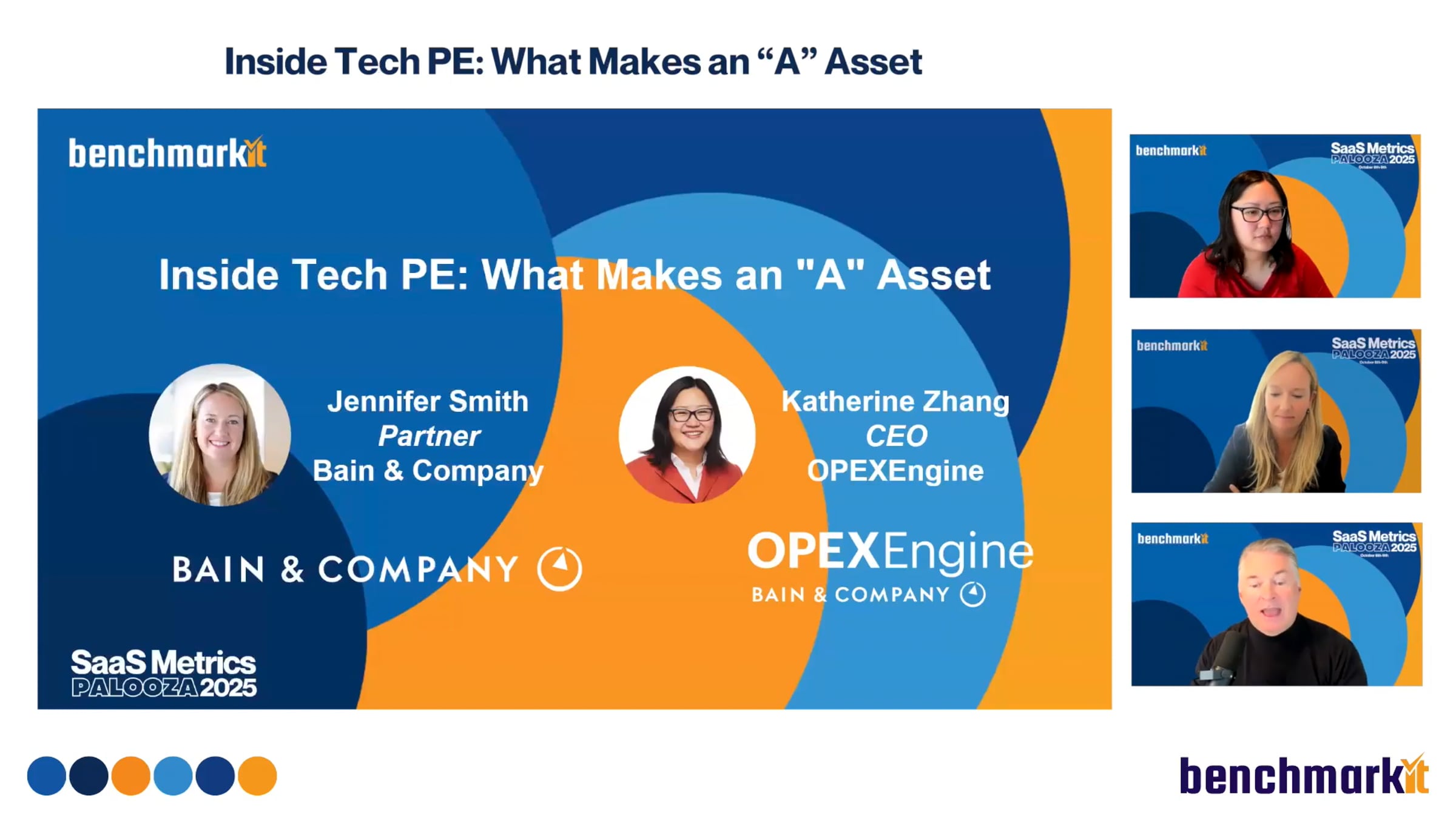
Inside Tech PE: What Makes an "A" Asset? at SaaS Metrics Palooza 2025

OPEXEngine was proud to return to SaaS Palooza this year as a gold sponsor and featured speaker. We led a session with Bain Partner Jennifer Smith titled: “Inside Tech PE: What Makes an ‘A’ Asset?”
Speakers: Katherine Zhang (CEO, OPEXEngine by Bain & Company) and Jennifer Smith (Partner, Bain & Company)
Moderator: Ray Rike (CEO, Benchmarkit)
Get started for free
24/7 customer support
Our customer support team is available to help 24/7. Enterprise members also receive dedicated account managers and a guaranteed uptime SLA.
© 2026 Vimeo.com, Inc. All rights reserved.
TermsPrivacyYour Privacy ChoicesU.S State PrivacyCopyrightCookies