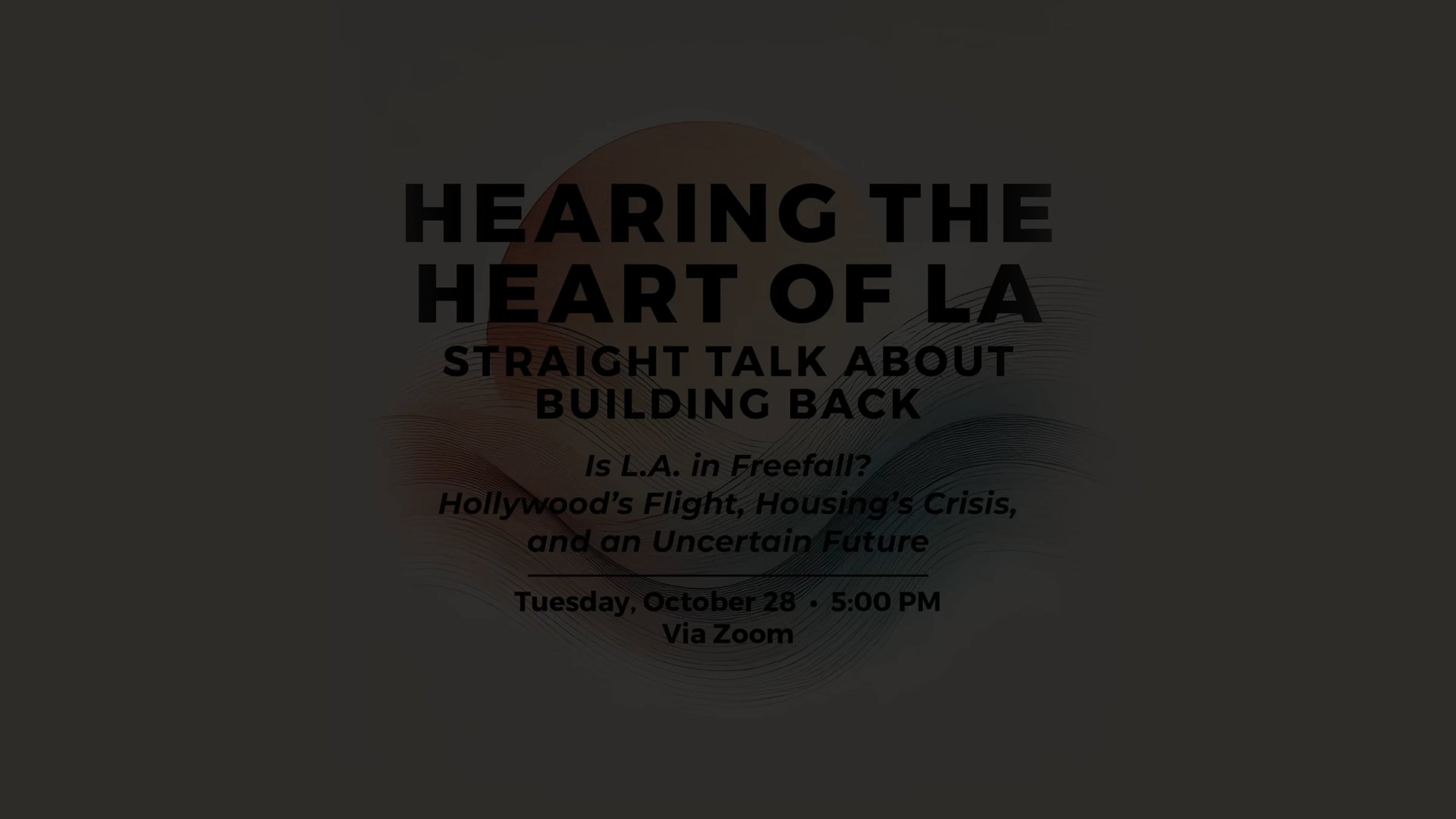
Straight Talk about Building Back: Is LA in Freefall?

The City of Angels has felt besieged lately, by catastrophic fires, ICE raids, an ongoing housing crisis, a collapse of jobs in Hollywood, budget woes – and the World Cup and Olympics are right around the corner. But is this worse than the city’s past bad moments? Is LA in freefall?
We posed this question at the latest outing of Heart of LA: Building Back, and got answers from people in the city’s dominant industries – Hollywood and real estate – as well as longtime city watchers. In sum, the city needs to get creative again, if it is to survive and thrive.
Keith McNutt, Director of the Western Region of the Entertainment Community Fund, which supports movie industry workers with healthcare, career development, emergency loans and housing, explained that four big hits – the pandemic, the strikes, runaway production and the fires – – had stressed the community beyond compare. “People who had savings… and might have prepared for one situation, one natural disaster, one loss of employment… they weren't. Nobody's prepared for four in a row.” He laid out some devastating numbers: “For 20 years, before the pandemic, we were providing $2 to $3 million a year in emergency grants… In the five years since the pandemic, we've provided over $60 million.”
While the recent expansion of state tax credits for movie production is already providing some relief, it doesn’t ease ECF's efforts to build for the entertainment community. McNutt has run into the city’s self-made obstacle to success: its maddening bureaucracy and permitting process. He described how an arts building to accompany Hollywood Arts Collective, a 152-unit housing complex for low-income artists, has been in process for 12 years, and its costs have doubled.
Bruce Fairty agreed. As Chief Chief Development Officer at Cypress Equity Investments, he has built multifamily housing in Boston, New York, New Jersey, Florida, Texas, Denver, San Francisco, and the Pacific Northwest. In Los Angeles he has run into multiple headwinds including transfer taxes, such as the controversial Mansion tax, and an inept DWP – “the worst utility company that I have dealt with in my 42 year career” – that have sent his costs skyrocketing. He said a project of his in Echo Park is now $7 million over budget.
Fairty and McNutt agreed these problems were endemic to the city of Los Angeles, and praised smaller cities including Culver City, Palmdale, Oxnard and Santa Monica (under new leadership), as well as a new generation of leaders that seems to be focused on problem-solving. For now, Fairty has concluded that “LA is one of the most hostile cities in the entire US to create housing,” and has ceased to build there. His investors have “redlined“ Los Angeles.
Responding to this bleak portrayal of the city once famed for it go-go spirit, D.J.Waldie, former city manager of the City of Lakewood, and author of essays and books about Los Angeles including his latest, Elements of Los Angeles: Earth, Water, Air, Fire, pointed out that while an “ethnic and political sorting” is underway, the “dysfunctional habits of city government in Los Angeles will continue.” This is because the city is suffering from a “problem of imagination,” adding, “There was a failure of charter reform in the 1990s. There's a lack of structural innovation in governance in Los Angeles, and in debt. There's a desperate failure of fostering a shared vision of this place and what it might be.”
Sam Lubell, who had written about past failures of imagination in his book Never Built: Los Angeles, suggested that LA has long been shaped by a push and pull between obdurate bureaucracy and individuals and grassroots groups with big ideas. He sees the same impulse at work now, in plans for the Olympics and for the rebuilding after the fires. You have “very creative people coming up with some really innovative solutions – group efforts to rebuild, or companies doing prefabrication or automated construction – and they're already coming up against major obstacles… You have to be really, really resilient and strong and maybe crazy to (realize these projects), but they do happen, and then other things follow… but it shouldn't be this hard.”
Speakers discussed LA’s DNA, both political– its weak mayor system – and cultural: Hollywood, which has fueled the optimistic, fanciful spirit of the region. “The entertainment business in Los Angeles…is the defining thing about LA,” stated FORT founder Russell Brown. McNutt agreed, saying that as an “Ohio boy” who witnessed the disappearance of that state’s auto, steel, glass and rubber industries, loss of a defining business “can happen, and we should be doing everything we can to fight to keep that signature part of our soul here.”
Probar gratis
Atención al cliente 24x7
Nuestro equipo de asistencia al cliente está disponible las 24 horas, los 7 días de la semana. Los miembros Enterprise también reciben gerentes de cuenta especializados y un SLA de tiempo de actividad garantizado.
© 2026 Vimeo.com, Inc. Todos los derechos reservados.
TermsPrivacyTus opciones de privacidadU.S State PrivacyCopyrightCookies