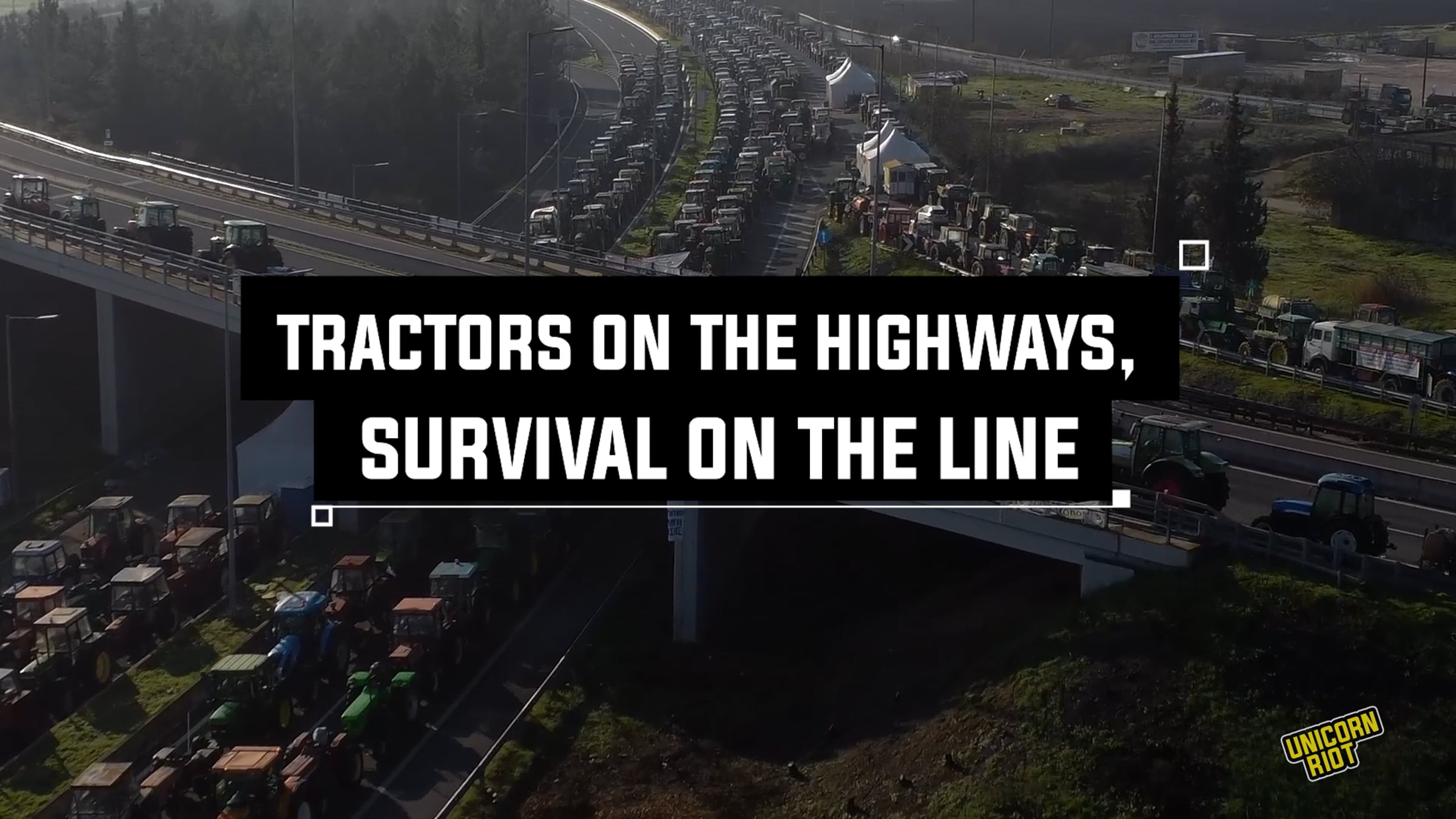
Tractors on the Highways, Survival on the Line: Greece’s Farmers Rise Up

Since Sunday, November 30, central roads across Greece have been paralyzed. The country keeps moving — but only via side streets — because tractors have blocked basic parts of highways. What began as localized demonstrations has escalated into one of the most extensive mobilizations in modern Greek history: customs offices have shut down, ports have been blocked, and airport access has been disrupted.
The image is striking. Long convoys of tractors stretch across national roads, their engines idling beneath banners demanding dignity, survival, and justice. In some places, farmers have parked their vehicles nose to nose, creating immovable barriers that slice the country into fragments. Greece is still moving, but only around them.
Across the country, farmers set up roadblocks in what they describe as a fight for survival. For many, this is no longer about negotiation or leverage. It is an existential struggle. “It cannot go on like this,” they warn, arguing that without immediate and structural change, small-scale farming in Greece will simply disappear.
At the blockades, people of all ages gather — men and women who have taken part in past mobilizations alongside those protesting for the first time. As evening falls, fires are lit from wooden pallets and scrap metal barrels. Coffee is poured, cigarettes shared. Conversations stretch late into the night.
They talk about earlier decades, about winters spent on highways in the older times, about roadblocks that once forced governments to negotiate. What is unfolding today is not unprecedented — neither in Greece nor elsewhere in Europe, where farmer-led protests have erupted repeatedly in recent years. But the scale of the current mobilization is different.
Farmers point out that today’s roadblocks are larger than those of 1996, which lasted three to four weeks. The current blockades have been in place already for four weeks at the time of publication, with no indication that they will be dismantled.
For many, this time feels different. Not because they believe victory is assured but because there is little left to lose.
“I have been actively participating in the mobilizations since 2009.” says Giorgos Beis, a second-generation farmer. Growing up watching his father work the fields, he knew from the age of seven that he would become a farmer — because he loved it. Today, Beis says, he would hesitate to encourage his own children to follow the same path.
“When I turned 18 back then, the problems were fewer; now, as we speak, they are more. We have reached a point where, in simple mathematical terms, we cannot cultivate — we cannot make it work.”
The costs of fertilizer, seed, fuel, electricity, and equipment have skyrocketed. At the same time, the prices farmers receive for their products fall below production costs.
“We work hard for a piece of bread,” Beis says. “We’ve reached a dead end. We are the only profession that works without knowing whether we’ll even get back what we are owed.”
As many farmers explain, making a living from agriculture has become increasingly untenable. To survive, many are forced to take on multiple jobs — working their fields by day and operating machinery, driving trucks, or doing seasonal labor whenever possible. Farming is no longer a livelihood on its own but seems like a component of a punishing double shift.
Full story: https://unicornriot.ninja/2026/tractors-on-the-highways-survival-on-the-line-greeces-farmers-rise-up/
Get started for free
24/7 customer support
Our customer support team is available to help 24/7. Enterprise members also receive dedicated account managers and a guaranteed uptime SLA.
© 2026 Vimeo.com, Inc. All rights reserved.
TermsPrivacyYour Privacy ChoicesU.S State PrivacyCopyrightCookies