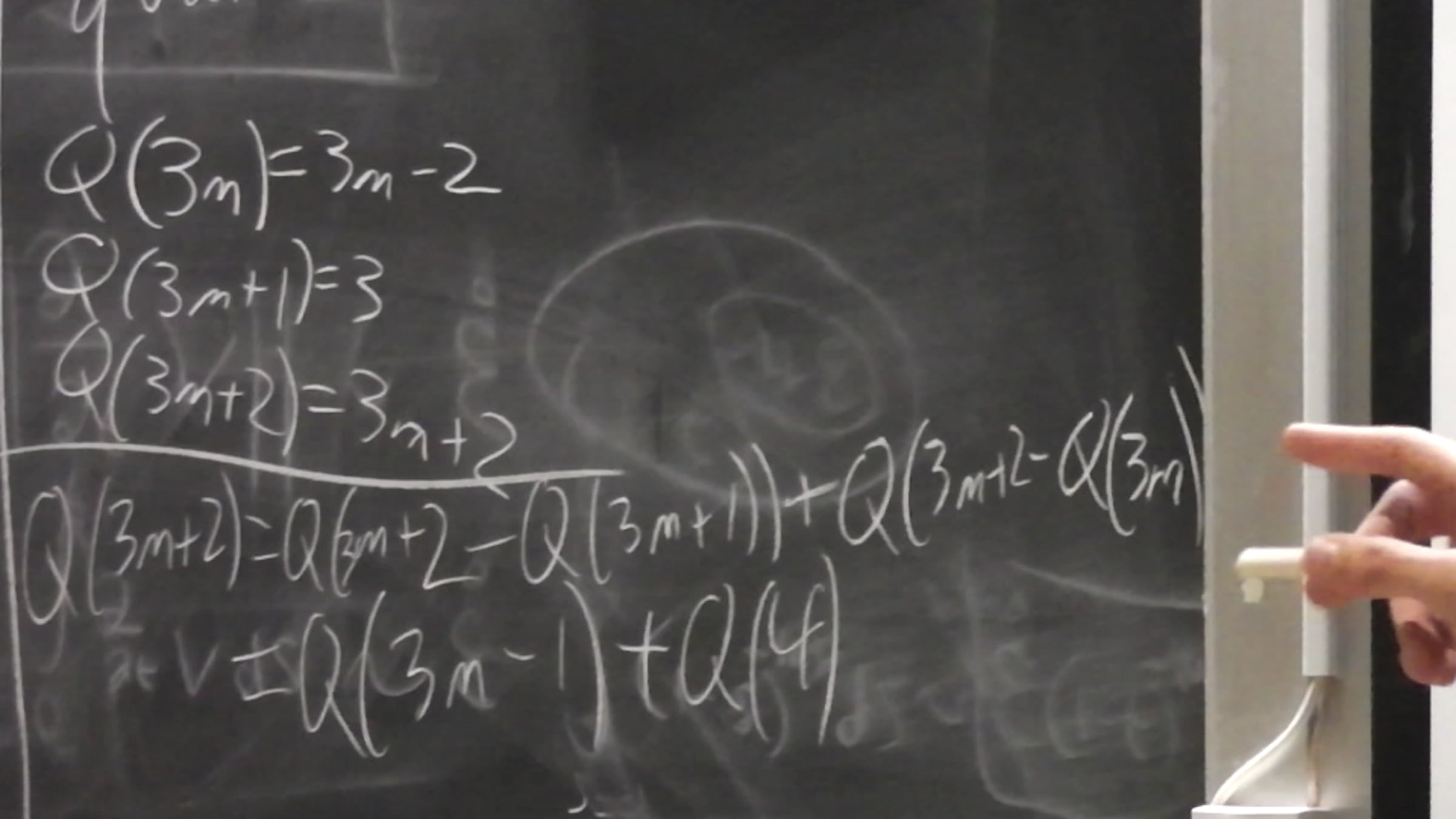
Hofstadter-like Sequences over Nonstandard Integers (part 1)

Nathan Fox, Rutgers Experimental Mathematics Seminar, November 10, 2016
See part 2 at vimeo.com/191094181
Abstract: The Hofstadter Q-sequences is defined by the recurrence Q(n)=Q(n-Q(n-1))+Q(n-Q(n-2)) with the initial conditions Q(1)=1 and Q(2)=1. Despite its simple definition, almost nothing has been proved about this sequence. Most notably, we still do not know whether Q(n) even exists for all n, i.e. if the sequence is infinite or if it "dies." On the other hand, many related sequences are known either to die or not to die. In this talk we will explore some variants of the Hofstadter Q-sequence, and we will describe a method for proving that certain infinite families of sequences all die. This method will involve constructing sequences whose indices and values can be nonstandard integers, which are "integers" that are larger than any natural number.
Get started for free
24/7 customer support
Our customer support team is available to help 24/7. Enterprise members also receive dedicated account managers and a guaranteed uptime SLA.
© 2026 Vimeo.com, Inc. All rights reserved.
TermsPrivacyYour Privacy ChoicesU.S State PrivacyCopyrightCookies