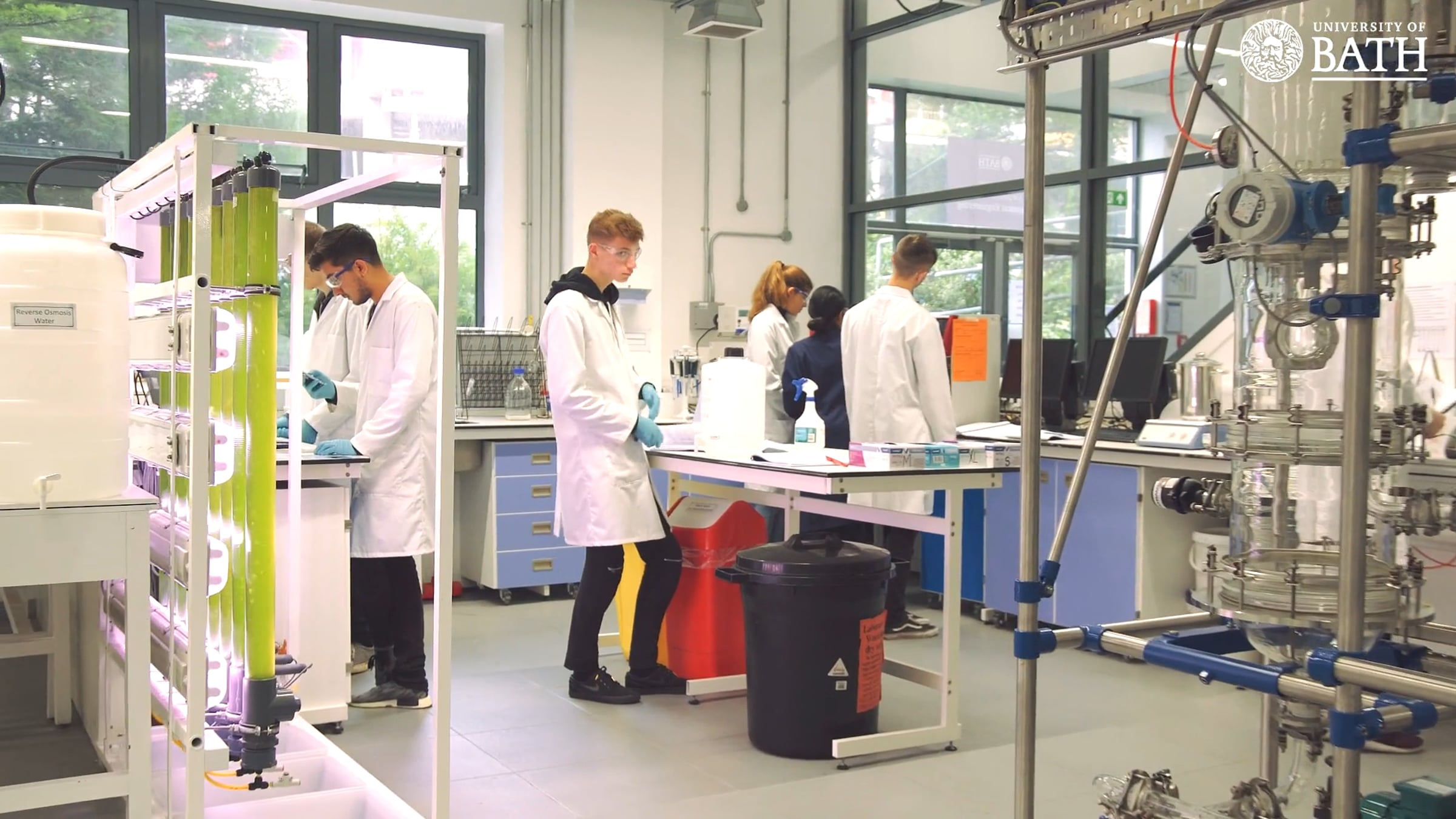
Chemical engineering undergraduate lab tour

Dr Chris Chuck takes us on a two minute tour of our chemical engineering undergraduate lab facilities, including an introduction to the basic techniques and equipment you could be using as part of your degree.
---
*Information correct at time of production. We may make changes to our courses or other aspects of your student experience in response to, for example, feedback from students, developments in the field of studies, the requirements of accrediting bodies, or any unforeseen or unavoidable circumstances. Always refer to the University of Bath's website for the latest information. The views and opinions of those taking part in this video are their own and not necessarily those of the University of Bath. : www.bath.ac.uk/corporate-information/disclaimer
---
Transcript. Dr Chris Chuck:
This is our undergraduate lab, this is where we do all our practicals. Where you could be looking at growing organisms such as algae or yeast, doing chemical reactions in a range of different reactors, or doing separations where you separate out the products that have been formed and purify them so they can be used.
Microalgae wastewater treatment
In this experiment, you'll be growing algae in a continuous culture to clean wastewater of phosphate and nitrates which leads to eutrophication.
Second generation bioethanol production
Another type of bio-transformation you'll be working on is yeast. This is an industrial style fermenter. You’ll learn how to run this and how to grow the yeast which can produce bioethanol, a second generation biofuel.
Absorption column
The other key part of chemical engineering is how you separate the products. We have a range of labs to show you the different techniques which are used. One of the ways is to use an absorption column which absorbs your key compound, the compound that you’re after, on to a inert material.
Reverse osmosis separation
Another key separation is desalination. Turning salt water into fresh water, removing the salt. This is our reverse osmosis membrane and this is a technique that’s used all over the world to produce fresh water from salt water.
Distillation column
We have a distillation column to distil out compounds which have a different boiling point. This is a key separation in most chemical processes.
Plug flow reactor
A key part of chemical engineering is learning all the different reactor types you can use to do chemical reactions. This one is a plug flow reactor where you can do a reaction very efficiently.
The assembly station
Finally, you can put everything together, to simulate the workings of a real chemical plant on the assembly station.
By using all of this state of the art technology, we give you the very best foundation to becoming a true chemical engineer.
Find out more about the University of Bath on our website at https://www.bath.ac.uk/
Probar gratis
Atención al cliente 24x7
Nuestro equipo de asistencia al cliente está disponible las 24 horas, los 7 días de la semana. Los miembros Enterprise también reciben gerentes de cuenta especializados y un SLA de tiempo de actividad garantizado.
© 2026 Vimeo.com, Inc. Todos los derechos reservados.
TermsPrivacyTus opciones de privacidadU.S State PrivacyCopyrightCookies