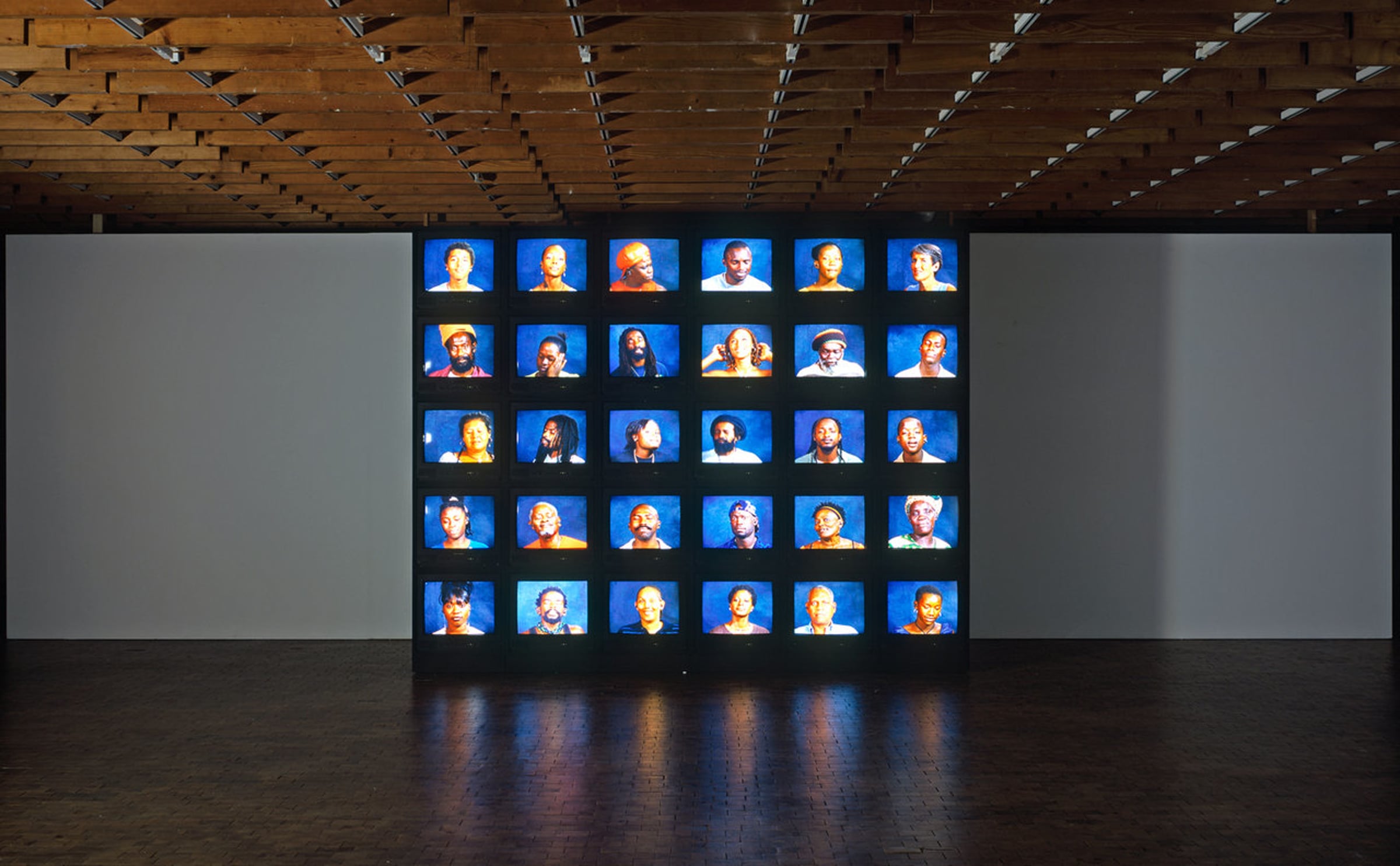
Legend (A Portrait of Bob Marley), 2005

Candice Breitz
'Legend (A Portrait of Bob Marley),' 2005
Shot at Gee Jam Studios, Port Antonio, Jamaica, March 2005
30-Channel Installation: 30 Hard Drives
Duration: 62 minutes, 40 seconds
Photograph: Jörg von Bruchhausen
Breitz’s experiments in the field of portraiture can cumulatively be described as an ongoing anthropology of the fan. Beginning with ‘Legend (A Portrait of Bob Marley),’ which was shot in Jamaica in 2005, Breitz has subsequently set up temporary portrait studios in Berlin [for ‘King (A Portrait of Michael Jackson)’], Milan [for ‘Queen (A Portrait of Madonna)’] and Newcastle [for ‘Working Class Hero (A Portrait of John Lennon)’]. The portraits have thus far followed the same procedural logic, and have been governed by the same tight conceptual framework. In each case, Breitz first sets out to identify ardent fans of the musical icon to be portrayed, by placing ads in newspapers, magazines and fanzines, as well as on the Internet. Those who respond to this initial call (typically numbering in their hundreds) are then put through a rigorous set of procedures designed to exclude less than authentic fans of the celebrity in question, in order to arrive at the final group of participants.
The individuals who appear in these works have thus stepped forward to identify themselves as fans, and have been included purely on this basis: all other factors – their appearance; their ability to sing, act or dance; their gender and age – are treated as irrelevant for the purpose of selection. Each of the selected fans is offered the opportunity to re-perform a complete album, from the first song to the last, in a professional recording studio. The conditions are thus set for a typological study, as each of the participants steps into the studio, one by one, to offer their version of the same album under the same basic conditions. Having set the parameters of the experience, Breitz then allows the performances to unfold with little directorial interference. It is left up to each fan to decide what to wear, whether to use props, how to address the camera, when and if to dance, whether and how to follow the lead or backing vocals, how to behave between tracks, and whether to mimic the original recording or seek interpretive distance from it. Diverse as they are, the portraits are collectively characterized by a riveting tension between the somewhat inflexible conditions under which each shoot takes place (conditions which both reflect and reflect upon the severe limitations for creativity within the commodified realm of mass entertainment), and the struggle of each fan to register an idiosyncratic performance despite these conditions. In the process of this struggle, the singers generate an a cappella cover version of the album that scripts the work, a re-recording which might best be described as a ‘portrait’ of the original album. Although the portraits stubbornly insist on the exact format and duration of the original albums that they take as their templates, they specifically exclude the auratic voices and familiar musical arrangements from the original version, so that the star in question ultimately remains present in the work only in the unaccompanied voices of his/her fans.
The portraits evoke their mainstream entertainment counterparts (such as American Idol or Pop Idol), but also take significant distance from their reality television cousins: Breitz promises her subjects neither fame nor fortune. What she offers them is an opportunity to record the songs that have come to soundtrack their lives in whatever way they choose. The non-hierarchical grids that she uses to organize the final presentation of the fans in each portrait, allow Breitz to deliberately sidestep the question of who has fared better or worse under the conditions that she has created for these quasi-anthropological visual essays on the culture of the fan. Whether the fans who pay tribute to their icons in her portraits are victims of a coercive culture industry or users of a culture that they creatively absorb and translate according to their needs, is left to the viewer to decide. If the dignity of the portrayed fans remains surprisingly intact, it is because rather than prompting us to laugh at the fans that she lines up, Breitz forces us to reflect on the extent to which pop music has infiltrated our own biographies.
Titling the series of works as she does, Breitz asks that we locate these multi-channel installations within the genre of portraiture, and prompts the question of how they in fact relate to this most humanist of genres. Though the title of a work may announce that it is a portrait of ‘Michael Jackson’ or ‘Madonna,’ these celebrities remain conspicuously absent in the final installations.