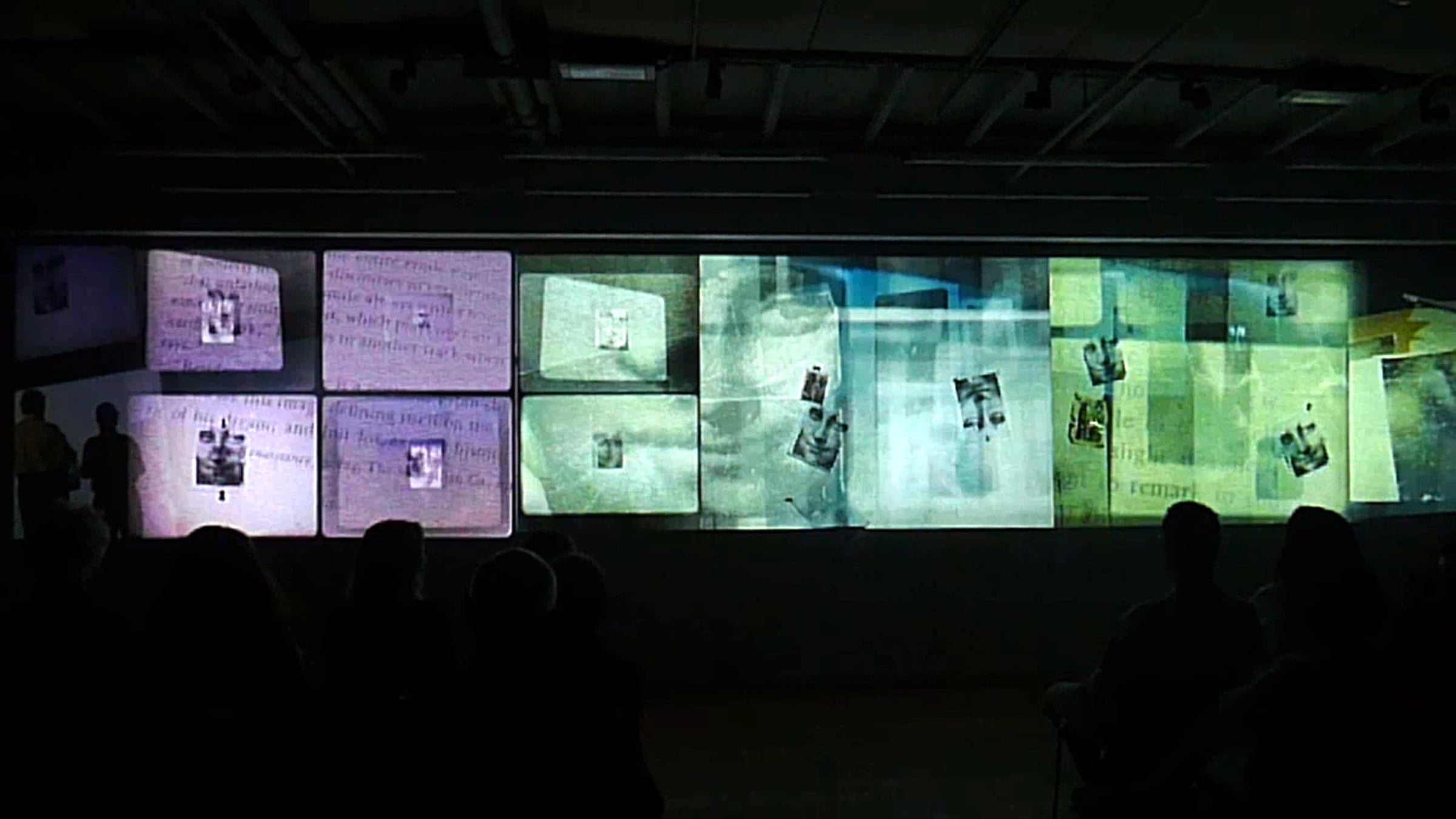
Stefano Miraglia, Eighteen fragments from Malcolm Le Grice's After Leonardo, 2016

Eighteen fragments from Malcolm Le Grice's After Leonardo.
BFI Southbank, Blue Room, 27 May 2016.
Edited by Stefano Miraglia
malcolmlegrice.com/
"This installation or performance work puts my own earlier film of the Mona Lisa (1973) through another stage of transformation – my own irretrievable self of some 34 years ago is now also part of the subject I first saw the ‘actual’ ‘Mona Lisa’ when I was about thirteen. Of course I had seen dozens of reproductions in books and postcards by then and the popular mythology of the enigmatic smile was already well engrained in my mind. My strongest impression, as I recall, was how small and unsurprising it was – a heavily protected cultural icon – no longer really a picture – and I was much more excited by the painting of the distant landscape than by the face. My own ‘version’ of ‘la Giaconda’ was never an homage, nor like Marcel Duchamp’s ‘L.H.O.O.Q’, an attack on its cultural power. Instead it came from a fascination with change and transformation – maybe also with arbitrary appropriation. The black and white close-up reproduction of the centre of the face that I had torn from a magazine years ago as a student, showed not the mystery of the smile but the strong signs of deterioration – the cracking paint – and then more closely the printing dots of the half-tone screen. Later, after some years of my careless handling, it had developed the cracks of the glossy paper surface itself. I saw the cracks and tears as material ‘symbols’ of the passage of time but also the change of meaning in culture. When I made my first film version of ‘After Leonardo’ in 1973. it was the additional layers of transformation and deterioration that I saw as the subject. The ‘Mona Lisa’ icon acted as a trace of the paradox between cultural permanence and the transience of the moment. Filming the picture then re-filming and re-filming the re-filming degraded the image but added a new dimension of motion and time – the motion of the observing camera and the duration of the performance. Freud’s monograph on Leonardo helped place my own abduction of the image into a context of cultural excavation. Changing meaning by digging below the surface, much as paintings are X-rayed. For me this was not a search for a new historical truth about Leonardo or the ‘Mona Lisa’ but the exploration of a continuing puzzle about the passage of time – the inadequacy of the arbitrary passing moment and the impossibility of permanence." Malcolm Le Grice
Bio:
Stefano Miraglia (Málaga, 1988) is an Italian-Spanish artist and curator based in Paris.
Often composed from diaristic and archival images, his films explore the notion of collage in cinema, combining noise music, photography, documentary and abstraction. His work has been presented internationally in exhibition spaces such as the Taiwan Contemporary Culture Lab (Taipei), Fabrica research center (Treviso), Le dôme (Montbazon), Centrum (Berlin) and in numerous film festivals such as Prismatic Ground, ICDOCS, Vienna Shorts and Festival des Cinémas Différents et Expérimentaux de Paris - where his film Anoche received an award in 2017. Since 2018 he has curated and presented several programs of experimental and artists’ films. Stefano is the founder and principal curator of Movimcat, an online project for the dissemination of artist’s cinema. Since 2019 he has been working on the rediscovery and reappraisal of the work of Ellis Donda. Stefano Miraglia is a member of the French association of art curators C|E|A.
Get started for free
24/7 customer support
Our customer support team is available to help 24/7. Enterprise members also receive dedicated account managers and a guaranteed uptime SLA.
© 2026 Vimeo.com, Inc. All rights reserved.
TermsPrivacyYour Privacy ChoicesU.S State PrivacyCopyrightCookies