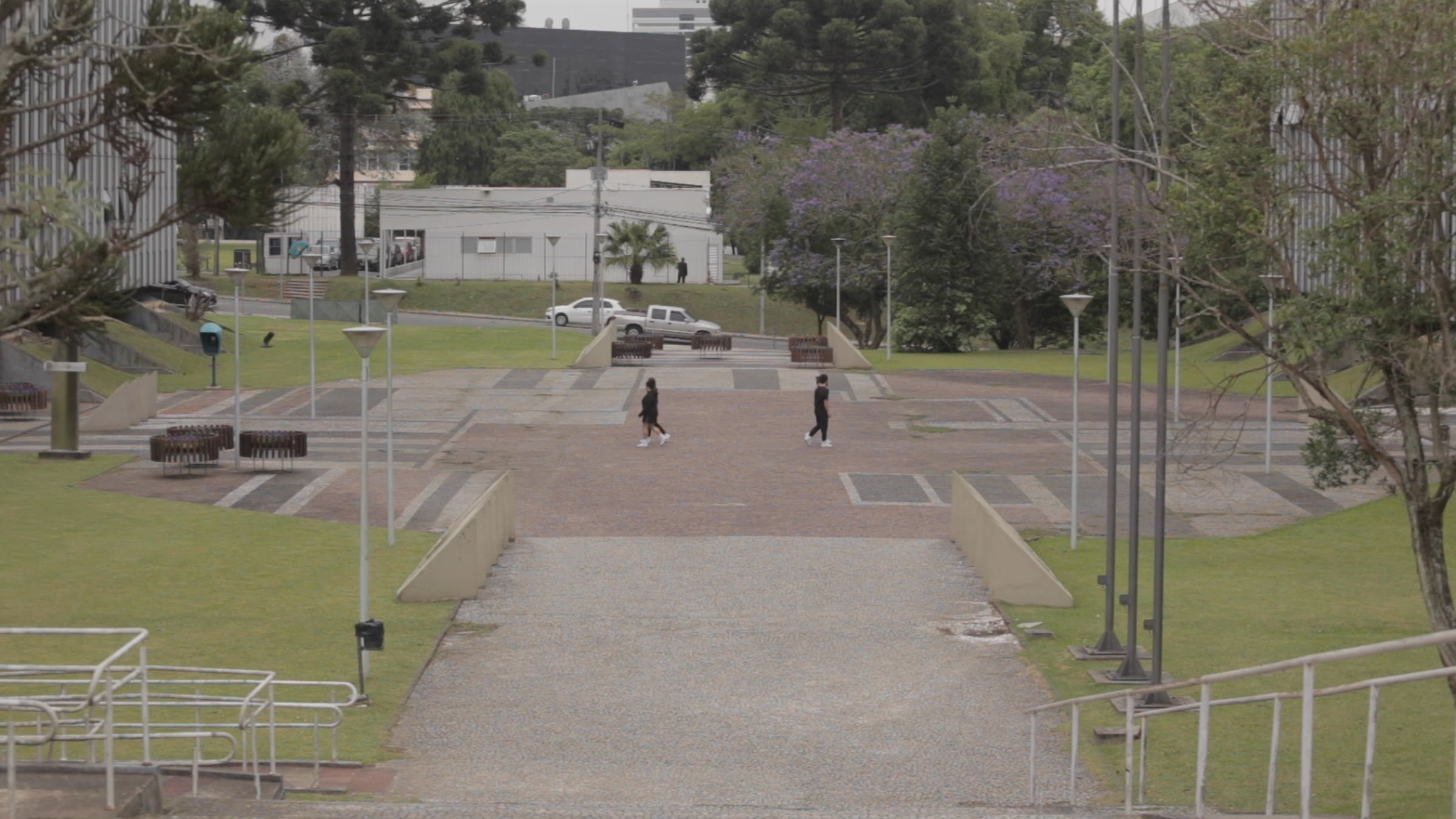
Coreografia estudo#1 (extract)

The etymology of the word choreography is "writing for a choir", or, “written to move together”.
Choreography has served to organize the state and its war machine. According to André Lepecki* dance has always existed, but its codification in the form of choreography was captured by the state. The first functions of choreography were to organise heteronormativity and reproduction, i.e. one danced to learn good manners, to perform at court, to find a wife or a husband.
"Choreography study#1" is a study about structure, control and the architectural capacities of choreography. In this study, geometric drawings based on numerical patterns define the trajectories of four dancers. There is a minimum amount of elements in the score, which are repeated and recombined. It is through interruptions of the unison and through desyncronisation that different paths and new relationships emerge between the dancers. This short choreography is mechanical and labyrinthine. It is a calculation that becomes vertigo. An optical puzzle.
The creation of this score was inspired by one of Trisha Brown's "Early Works" (1960s).
Curitiba/Brazil
2016
.:.
Choreography and Scores: Michelle Moura
Co-choreography and performance: Bernardo Stumpf, Bia Figueiredo, Cândida Monte, Thaisa Marques
Music: Kaj Duncan David
Clothes: Caroline Ricca Lee
Collaboration in creation: Bárbara Wagner, Javier Calderón, Mario Lopes, Paulina Vielma, Sol Dugatkin
Acknowledgements: Mario Lopes, Javiera Peón-Veiga, Casa Hoffmann/Curitiba, Cristina Herrera/Cultural Gate, Daniel Kairoz/Terreyro Coreográfico, Grupo Vão.
Support/residence: PLUSbrasil Platform at Villa Walberta, Feldafing/Germany. NAVE, Santiago/Chile
This project was awarded the Funarte Dance Prize Klauss Vianna 2014
Duration: 45 minutes
Probar gratis
Atención al cliente 24x7
Nuestro equipo de asistencia al cliente está disponible las 24 horas, los 7 días de la semana. Los miembros Enterprise también reciben gerentes de cuenta especializados y un SLA de tiempo de actividad garantizado.
© 2026 Vimeo.com, Inc. Todos los derechos reservados.
TermsPrivacyTus opciones de privacidadU.S State PrivacyCopyrightCookies