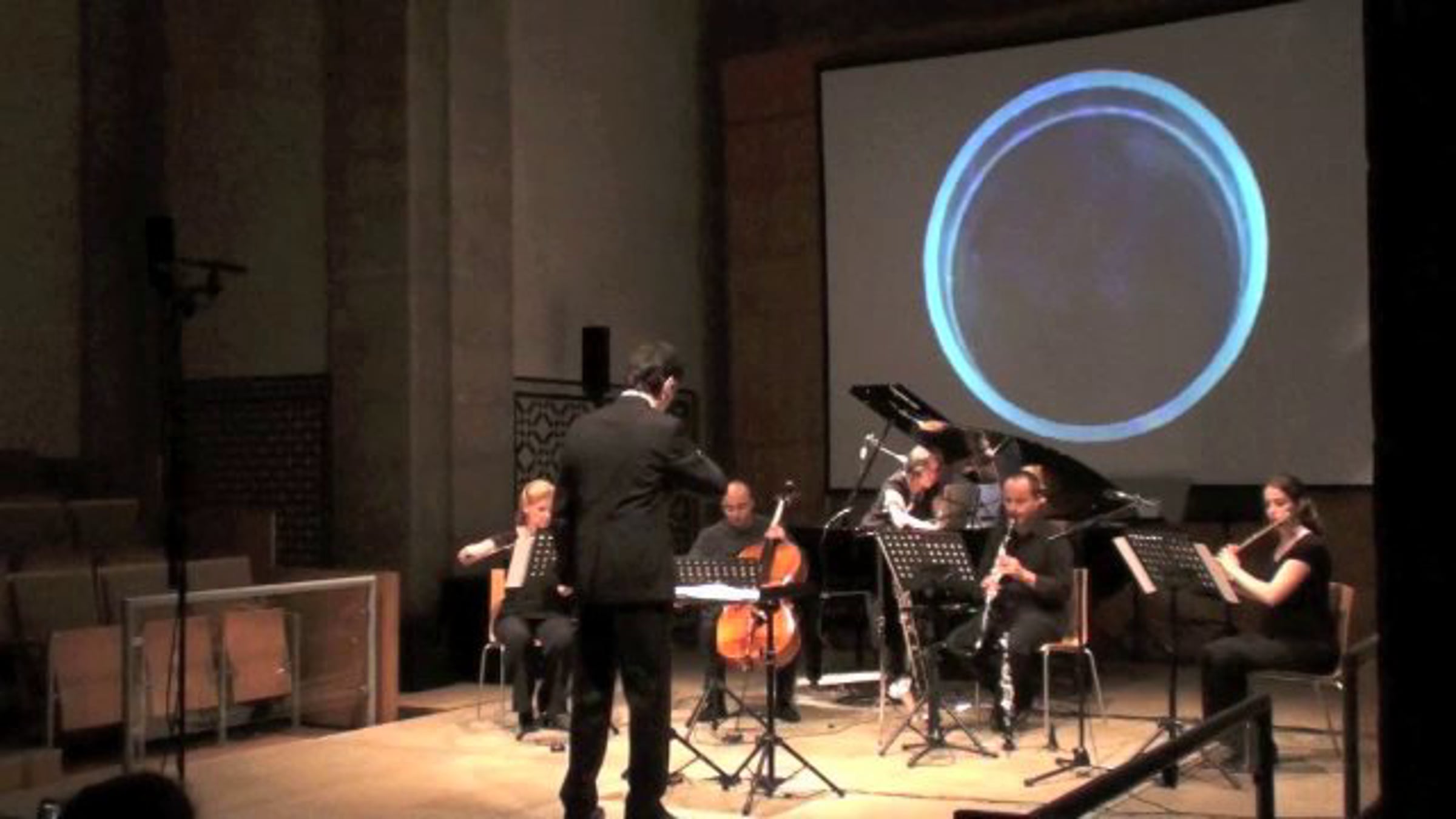
Die Lebensfreude - Premiere by Sond'Ar-te Electric Ensemble, Portugal

The piece was premiered in Cascais, Portugal, by Sond'Ar-te on 01 June 2012, under the baton of phenomenal French conductor Guillaume Bourgogne.
The piece has two movements: I - Machina Vita and II - Machina est finitum.
The motivation to compose this piece emerged after a painting by Max Ernst, Die Lebensfreude, from 1936, which I saw at the Scottish National Gallery of Modern Art in Edinburgh in the Summer of 2011. I learned that this work is a twist on a painting by Matisse with the same name. In contrast to the joyous nature of Matisse’s painting, Ernst spreads entangled leaves and tendrils across the picture and populates it with praying mantises. Lost in this sinister world is a diminutive human being alongside a crouching beast. This predatory jungle is an expression of the Ernst’s outrage at the worsening political situation in Europe during the 1930s. This piece is an attempt at conveying musically the feeling that this painting elicited on me. At that time, I was conducting a research project with a scientist in Bristol, Prof Andrew Adamatzky, looking into rendering the behaviour of an amoeba-like slime mould called Physarum polycephalum into sound. Scientists are looking into the possibility of harnessing the behaviour of this mould in order to build biological computers. As this mould inhabits shady, cool, moist, shaded areas over decaying plant matter, I had the idea of using the results of my research to compose this piece. The electroacoustic parts (6 channels) are direct sonifications of a computer simulation of the mould foraging for food: it eats bacteria and dead organic matter. The instrumental part (flute, clarinet, piano, violin and violoncello) was generated by the same simulation. Although the timings of the events generated by the computer were preserved intact, I adapted the notes to fit my compositional aims. A visual animation of the simulation that generated the materials for the composition is displayed during the performance. However, the images are twisted by the performers as they play: the music controls software that distorts and superimpose other images to visual animation in real-time. The intention here is the opposite from Ernst’s intention: the musicians attempt to turn the sinister atmosphere of the piece more joyous. Die Lebensfreude is dedicated to Miguel and Paula Azguime.
Get started for free
24/7 customer support
Our customer support team is available to help 24/7. Enterprise members also receive dedicated account managers and a guaranteed uptime SLA.
© 2026 Vimeo.com, Inc. All rights reserved.
TermsPrivacyYour Privacy ChoicesU.S State PrivacyCopyrightCookies