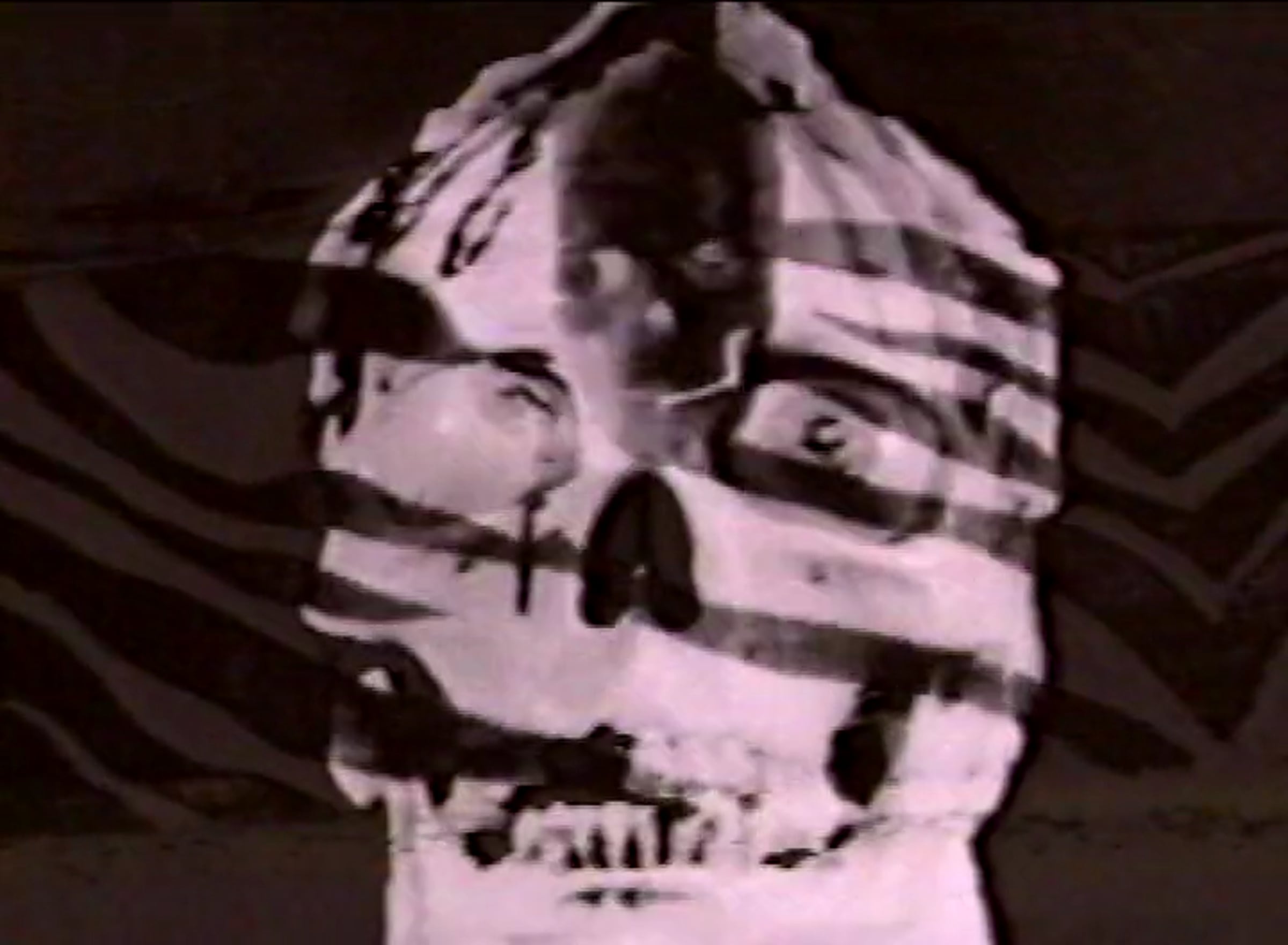
Gen Locked Skull

As far as I can recall, this was the first time I experimented with the Sandin Analogue Image Processor and made a video tape from it. I was a student at the School of the Art Institute of Chicago's Video Area in a beginning image processor class called Video Synthesis. I attended this class, taught by Professor John Manning, in the spring of 1981. My original tape incorrectly showed the year as 1980. I've repeated sections for better viewing.
I used Skully as my main subject. Skully was a plastic model skull that we used as a prop and mascot in Skull Club* rituals. Another small skull came from a plastic model of a human skeleton. The magenta color in one clip came from a video tape I mixed with the live processing. I believe the zebra pattern was fabric that a female student loaned me. One way to work with the image processor was to run multiple black and white surveillance cameras into it, each one pointed at some different part of the scene. I believe I had one camera for Skully and one for the small skull placed on the zebra fabric.
These outtakes came from a longer continuous tape made with the image processor in one live session. I called this original tape "Gen Locked Skull." After editing most of the clips we see here into my later piece "Trans-Mission" I taped over the original. These are the best "Gen Locked Skull" clips salvaged from "Trans-Mission." The first segment is all that's left from the original "Gen Locked Skull" tape. The phrase "gen lock" refers to a technical aspect of the piece, the fact that the image processor's synchronization was locked to an external video tape. That external tape shows up in a color clip as the magenta parts of the image, as mentioned earlier.
*For more info on the Skull Club see: https://www.facebook.com/theskullclub/.
無料で始める
24時間年中無休のサポート
Vimeoのカスタマーサポートチームが24時間年中無休で対応します。Enterpriseメンバーには、専用のアカウントマネージャーがつき、保証された稼働時間SLAが提供されます。
© 2026 Vimeo.com,Inc.All rights reserved.(不許複製・禁無断転載)
TermsPrivacyお客様のプライバシー選択U.S State PrivacyCopyrightCookies