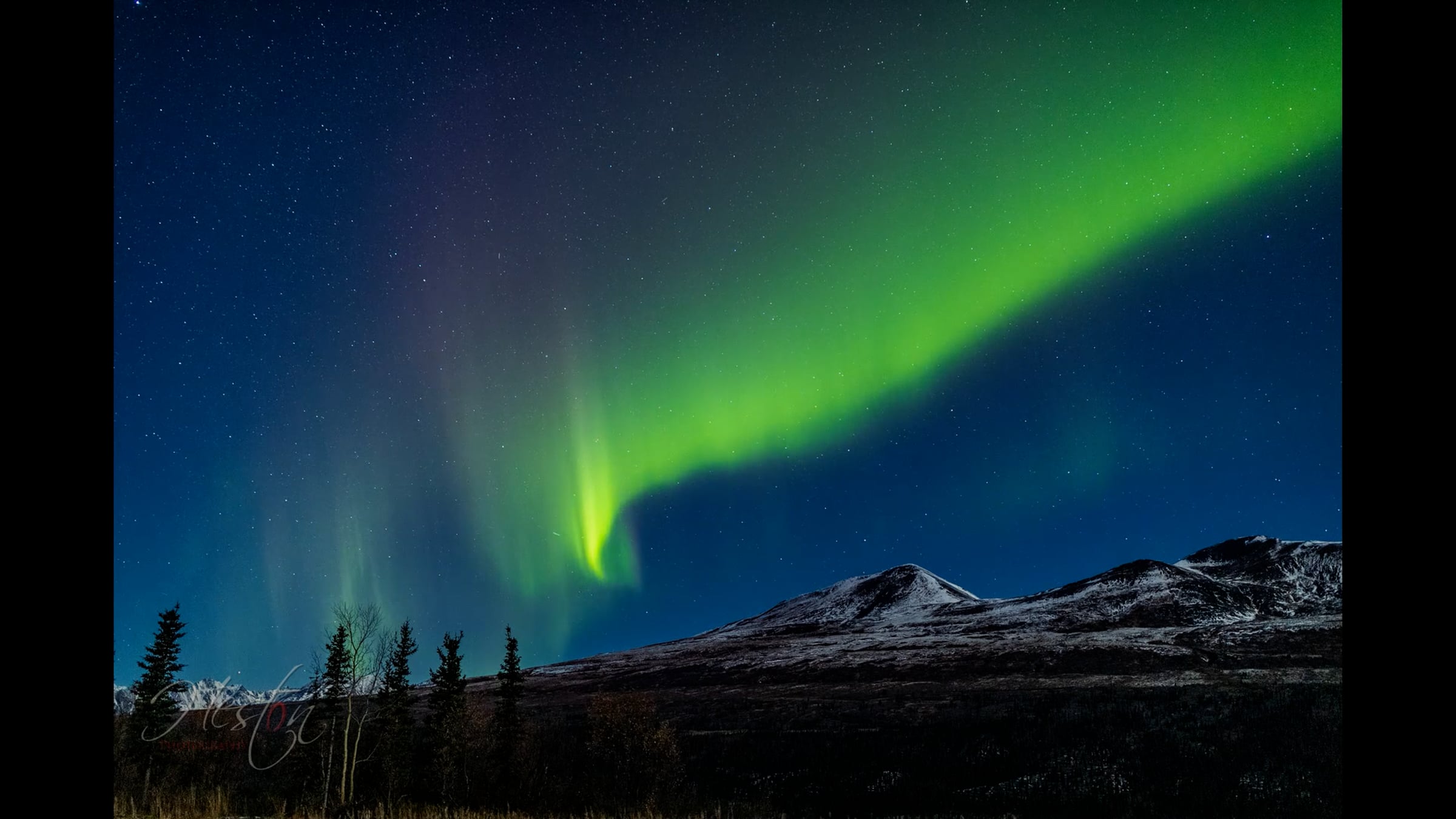
Auroras from Monday September 27-28

Camera A, 0:00, For the first 04 seconds you will see a very faint aurora. Standing there I could make out a faint green band, by my (our) eyes cannot make out the red band in such low light.
Camera A, 0:04, As the moon rises the faint green & red bands appear softer and fainter, due to the brightness of the moon light.
Camera A, 0:28, You will see a stronger aurora starting at the right and working its way across the sky over the moon. At times the green band is as bright as the moon (moon about 65%)
Camera B, 0:52, the auroras continue to arc across the sky and dance left to right with the red band getting stronger and visible to the naked eye.
Camera A, 1:23, the aurora fades but then comes back stronger.
Camera B, 1:39, the auroras are very active with spikes shooting up
Camera A, 2:04, Better detail of the spikes, now running left to right
Camera A, 2:23, To the northwest the sky begins to light up with “ribbons”/”curtains” of color twisting, bending, and winding across the sky.
Camera A, 3:01, The sky starts to come alive filling the camera with color and movement. It almost appears to exploded at one point. At this point the lights are very bright.
Camera A, 3:17, The auroras start to pulse, an aurora action I had not seen before this.
Camera A, 3:24, The pulsing continues, just fainter than before making the pulsing easier to see.
Details:
First image was taken at 10:47pm, last one at 5:13am. Image interval is every 7 seconds. I have cut 75% of the frames to prevent boredom.
This video is comprised of 1123 images x 7 seconds per frame/image = 131 minutes of “sky” time compressed into 3:47 seconds. So, what you are watching is running at about 10x real speed.
5.18 frames per second
37 seconds of real time = 1 second of video
Canon 1Dx2, 35mm 1.4 and 14mm 1.8
Exposure: ISO 3200, Aperture - wide open, time 1.3 to 3.2 seconds
Get started for free
24/7 customer support
Our customer support team is available to help 24/7. Enterprise members also receive dedicated account managers and a guaranteed uptime SLA.
© 2026 Vimeo.com, Inc. All rights reserved.
TermsPrivacyYour Privacy ChoicesU.S State PrivacyCopyrightCookies