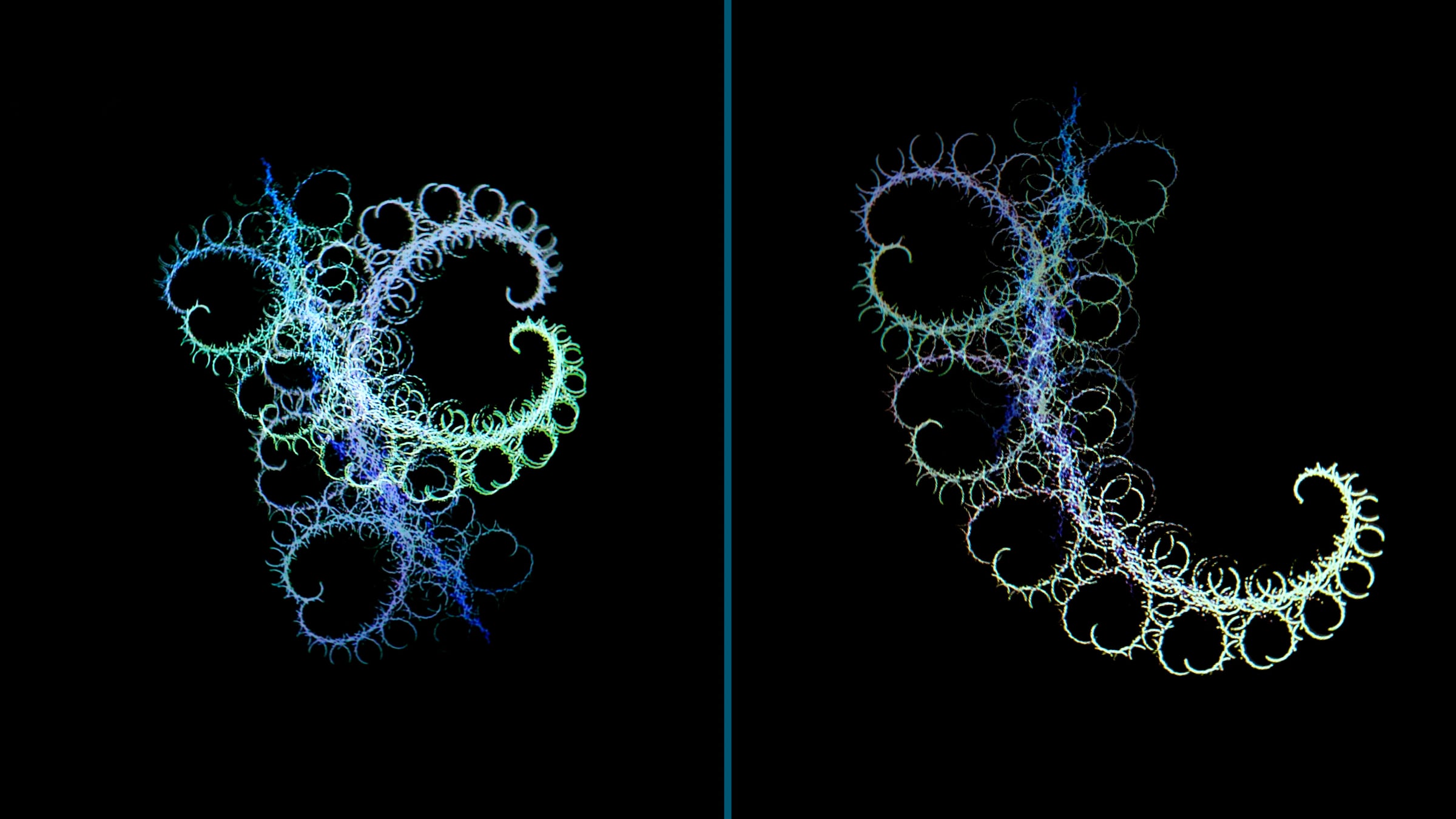
Insanity Mode: Fractals Made of Fractals Made of Fractals...

In this mode of the Video Feedback Kinetic Sculpture, each of the four monitors effects every other monitor, and the image on the left is composed of the image on the right, while the image on right is composed of the image on the left - all at once (they create each other!) - making fractal sets within fractals sets within fractal sets within fractal sets...
Here, there's a feedback loop between two cameras and two monitor structures (each monitor structure has a top and bottom monitor with a sheet of beam splitter glass between the two). There's also a feedback loop between the monitor structures themselves, where the image created on the left structure is sent to the right structure, while the image created on the right structure is sent to the left structure.
See the Device here: https://youtu.be/3uzxcl_d8uk?si=dA0fBsE5h-33imIu
More videos and information on the Light Herder Project: https://www.thelightherder.com
Three high definition camera feedback loops and beam-splitter glass, combined with an Insanity Mode of a feedback loop between feedback loops themselves, mix together to create fractal sets within other fractal sets, cell structures, strands of DNA, trees, insects, tentacled primordial creatures - a combination of movements and settings that result in never identical ephemeral visual output.
The device now has two monitor structures. Both structures have two HD monitors (with analog hue/contrast/saturation knobs) at right angles to one another, with a sheet of beam splitter glass between them. The feedback loop between these two monitors, the reflection in the glass, and the camera, creates fractals in real-time, without a computer.
Using the video switchers, the left monitor structure can interact with the right monitor structure, and vise-versa. When they both interact with each other at the same time, yet another feedback loop is created, producing unexpected and strange results (thus, Insanity Mode).
Switching quickly between an input and the camera looking at that input on a screen instantly "traps" that image within the system, now cycling 'round and 'round between camera and screen, contorting with each iteration.
Watch a video about images "trapped in the wires" here: https://vimeo.com/508776650
Made of maple, mahogany, aluminum, three cameras, five HD feedback monitors (with hue/saturation/brightness analog knobs), three Roland video switchers, two viewing monitors, two sheets of beam splitter glass, and a video input, the mechanism makes high definition analog video feedback as never before created.
Dedicated to Douglas Hofstadter, who taught me to love all things self-referential.
Feedback loops are all-important, and are present in ecosystems, geological systems, social systems, biological systems, and it’s no wonder the images created using the structure are so organic looking. Gazing into this feedback allows for insights into the magic of recursion.
But where do these images come from you might be thinking, and why do they actually exist? Once initiated, they come from themselves, and exist because they exist.
Imagine a dark room where a camera is looking at a screen which displays the output of that camera. The screen will stay void of an image forever until a “spark of life” (say the lighting of a match) brings forth an image, which will then continue on and on, changing through iterations. That pattern now exists within the wires of the system, long after the original spark is gone.
See an example of feedback started with a "spark of life" here: https://www.thelightherder.com/2010/01/feedback-machine-test-number-three.html
But, then imagine something blocks the camera’s view of the screen, just for an instant. All of a sudden, the image goes out, and the camera sees a dark screen again, which displays what the camera sees, etc... now blackness replaces the pattern. It would be impossible to find these feedback images by looking at the wiring of the system, by dissecting the cameras and monitors.
This may be like the mind - you can't find consciousness just by inspecting the nerves and connections of the brain. The mind is a pattern that grows through feedback, iterations over time. Once that pattern is interrupted (something blocks the camera's view of the monitor), the pattern disappears, leaving just the organic mechanism.
So this may answer the question "where do we go when we die?" - the same place the snowflake's pattern goes when the snowflake melts?
Get started for free
24/7 customer support
Our customer support team is available to help 24/7. Enterprise members also receive dedicated account managers and a guaranteed uptime SLA.
© 2026 Vimeo.com, Inc. All rights reserved.
TermsPrivacyYour Privacy ChoicesU.S State PrivacyCopyrightCookies