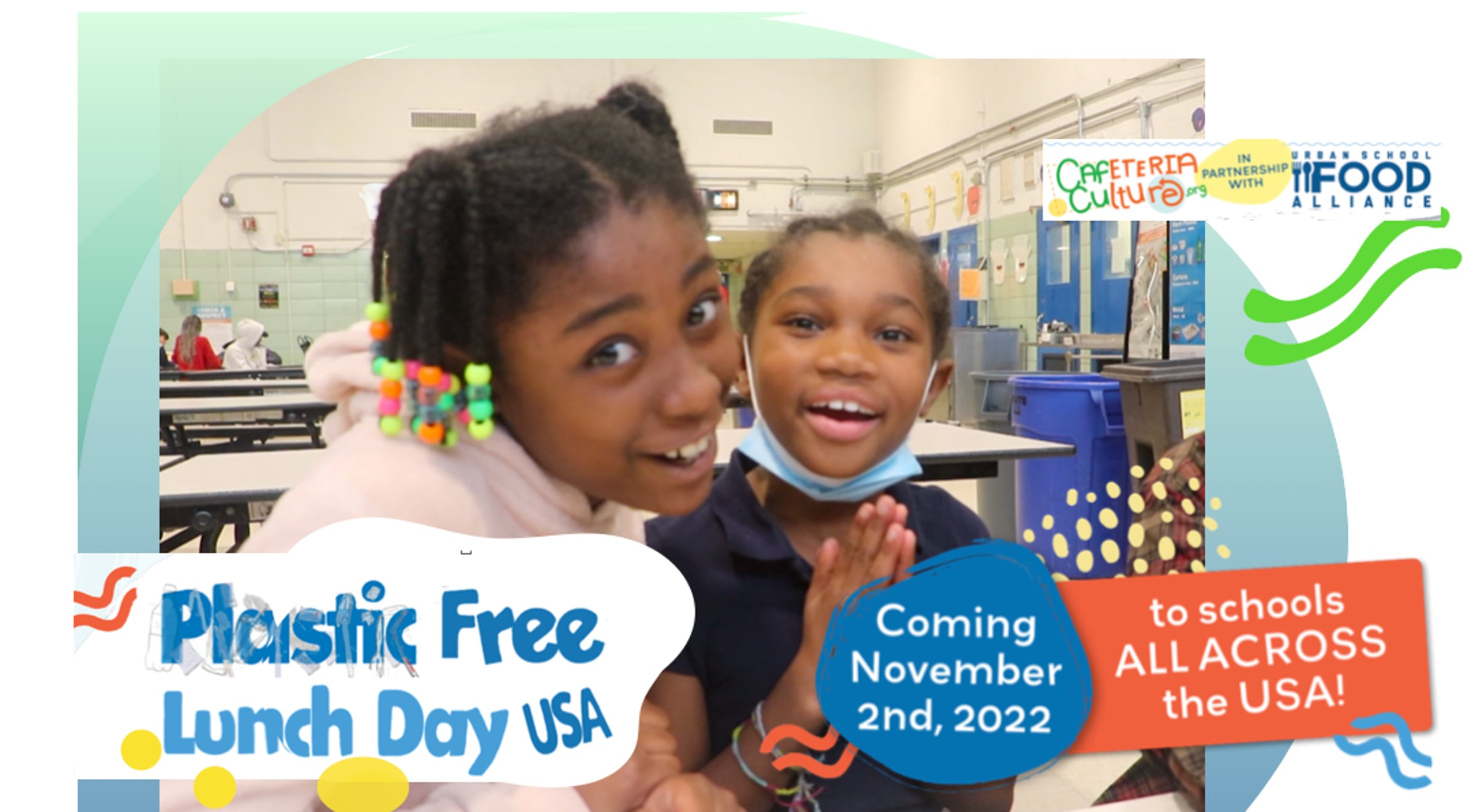
Plastic Free Lunch Day - Get Ready, USA Schools!

On November 2, 2022, Cafeteria Culture and Urban School Food Alliance (USFA) invite you to join New York City, Dallas, and other USFA members–seventeen of the nation’s largest school districts–for the first ever Plastic Free Lunch Day USA!
This national plastic-free day will reduce plastic packaging in public school cafeterias to protect student health and for the environment.
Details and free resources at:
www.plasticfreelunch.org
What is Plastic Free Lunch Day?
- A day when school lunch is prepared without plastic!
- An action day to reduce as much plastic as possible.
- A way to protect the environment and student health.
- Provide a glimpse of a plastic-free school cafeteria future.
- Connect with students everywhere who are taking climate action in their cafeteria.
Cafeteria Culture is an environmental education nonprofit and the force behind the award-winning student-led film Microplastic Madness. Plastic Free Lunch Day grew out of Cafeteria Culture’s partnerships with the New York City students, DOE Office of Sustainability, and DOE Office of Food and Nutrition Services, a founding USFA member.
The first Plastic Free Lunch Day (PFLD) was spearheaded by fifty-six PS 15 fifth-graders in Red Hook Brooklyn, as portrayed in Cafeteria Culture’s award-winning student-led movie, Microplastic Madness. On PFLD, students eliminated plastic utensils, drinking cups, and condiment packets. Students conducted a before and after waste audit and on PFLD counted 558 fewer lunchtime single-use plastic items!
Nationwide, school cafeterias serve 7.35 billion meals annually, making a large contribution to the global plastic waste stream. School lunches are loaded with single-use plastics, such as plastic wrap, utensils, utensil wrap, cups, lids, bowls, straws, condiment packets, cartons, chip & snack bags, baggies, clamshells and styrofoam trays. Collectively, US school cafeterias have the potential to significantly reduce plastic pollution.
Most plastic is not recycled and ends up in landfills or the environment. And because plastic does not biodegrade, it stays around for centuries, endlessly fragmenting into small pieces, first microplastics, then nanoplastics. Plastic pieces now permanently contaminate our soil, water and air. We eat a credit card’s worth of plastic each week and we breathe even more. Scientists have found plastic particles in the human placenta, and in our lungs, liver, digestive tract and blood. Plastic food packaging and foodwarer create additional health problems. They leak petrochemical monomers, heavy metals, and persistent organic pollutants into our food and drink. About 12% of plastic is burned in incinerators where it emits dioxins and other toxic gases.
www.plasticfreelunch.org
Get started for free
24/7 customer support
Our customer support team is available to help 24/7. Enterprise members also receive dedicated account managers and a guaranteed uptime SLA.
© 2026 Vimeo.com, Inc. All rights reserved.
TermsPrivacyYour Privacy ChoicesU.S State PrivacyCopyrightCookies