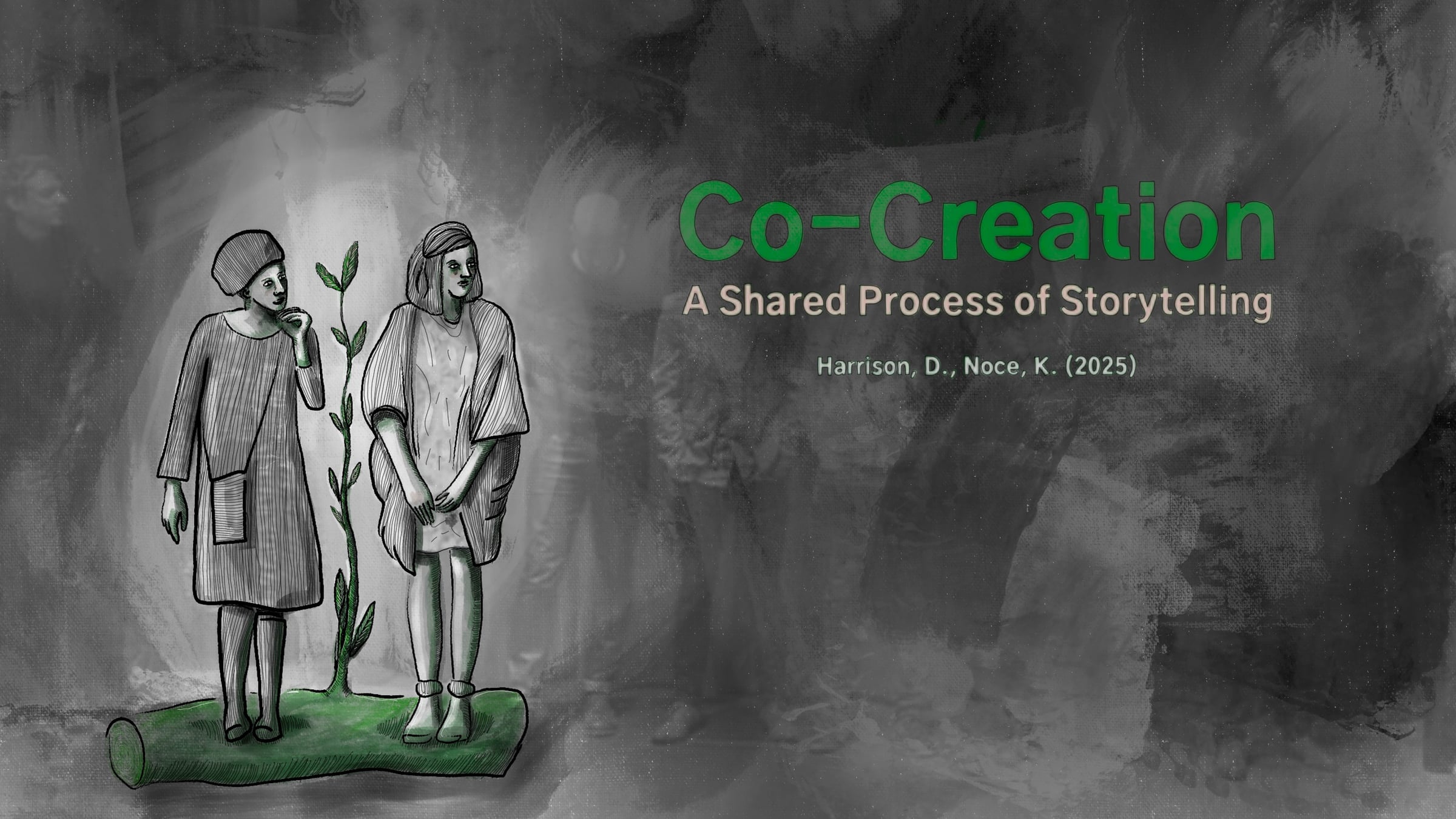
Co-Creation: A Shared Process of Storytelling - Harrison N., Noce, K. (2025)

Co-Creation: A Shared Process of Storytelling - Harrison N., Noce, K. (2025)
How and where films are made shape who is included, what stories emerge, and why they matter. Inspired by Ursula K. Le Guin (1998) we explore storytelling as a flexible vessel that evolves in response to what it holds. Co-creation expands authorship, ensuring films are collective inquiries. As Freire (1970) argues, knowledge is formed through dialogue and practice, making filmmaking a shared space of meaning-making, ethics, and responsibility.
Haraway (2016) frames storytelling as confabulation shaped by relationships rather than singular authorship. Albright’s Panaesthetics (2014) sees artistic disciplines as fluid and interconnected. In filmmaking, this shifts the creative process into something non-hierarchical. Seek-and-Hide (2019) demonstrates this through blind storytelling. Each artist animated without knowing the full narrative. This process fostered meaning through shared interaction.
In the accompanying workshop, participants will experiment with an outdoor storyboarding technique to co-create a short sequence.
We will explore how “En-Plein-Air” (ExEd24, 2024) environments alter co-creative storytelling. The session concludes by reflecting on alternative co-creation models, such as Anima Mundi (2024), which interweaves multiple perspectives within a shared thematic frame. This proposal invites discussion on co-creation as an educational and ethical practice, preparing the next generation of filmmakers to engage meaningfully with cinema’s transformative power.
Bibliography/Bibliografía
- Haraway, D.J. (2016) 'Staying with the Trouble: Making Kin in the Chthulucene'. Durham: Duke University Press.
- Freire, P. (1970) 'Pedagogy of the Oppressed'. New York: Herder and Herder.
- Le Guin, U.K. (1986) 'The Carrier Bag Theory of Fiction'. Carrier Bag Fiction, Spector Books, 2021.
- Albright, D. (2014) 'Panaesthetics: On the Unity and Diversity of the Arts'. New Haven: Yale University Press.
- Noce, K., Harrison, N. and Spink, A. (2018-22) Seek and Hide. Odisha Arts Biennale, India, Watford and Clapham Common, UK
- Noce, K., Martínez, A., Vega, V. and Xu, T. (2024) ExEd24 En Plein Air . University of the Arts London.
- Harrison N.; and Noce, K., Mulhearn, E., Bye, B., Rainbow, C., Alexandy, A., Park, D., Nunu, A., Modomatic, Y., Sun, Y., Grill, T. and Whaler, A. (2024) Anima Mundi: In The Garden – Giggles In The Greenery. Manchester Metropolitan University and University of the Arts London.
- Harrison N., Noce, K. (2018) Planning Seek and Hide. Private Collection.
- Harrison N., Noce, K. (2024) Diary of Two Wild Creatures. Quinta Des Relvas, Portugal/UK. Private Collection.
Co-creazione: un processo condiviso di narrazione — Harrison N., Noce K. (2025)
Il modo e il luogo in cui i film vengono realizzati determinano chi vi partecipa, quali storie emergono e perché sono significative. Ispirandoci a Ursula K. Le Guin (1998), esploriamo la narrazione come un contenitore flessibile che si trasforma in relazione a ciò che contiene. La co-creazione amplia l’autorialità, trasformando i film in indagini collettive. Come sostiene Paulo Freire (1970), la conoscenza si forma attraverso il dialogo e la pratica, rendendo la creazione cinematografica uno spazio condiviso di costruzione di significato, etica e responsabilità.
Donna Haraway (2016) interpreta la narrazione come una confabulazione plasmata dalle relazioni piuttosto che da un singolo autore. Per Albright (2014), le discipline artistiche sono fluide e interconnesse. Nel cinema, ciò trasforma il processo creativo in qualcosa di non gerarchico. Seek-and-Hide (2019) ne offre un esempio attraverso la narrazione cieca: ogni artista ha animato senza conoscere l’intera storia. Questo processo ha generato significato attraverso l’interazione condivisa. Durante il workshop, i partecipanti sperimenteranno una tecnica di storyboard all’aperto per co-creare una breve sequenza.
Esploreremo come gli ambienti “En-Plein-Air” (ExEd24, 2024) influenzino la narrazione co-creativa. La sessione si concluderà riflettendo su modelli alternativi di co-creazione, come Anima Mundi (2024), che intreccia molteplici prospettive all’interno di una cornice tematica comune. Questa proposta invita a discutere la co-creazione come pratica educativa ed etica, preparando la nuova generazione di cineasti a impegnarsi in modo significativo con il potere trasformativo del cinema.
Co-creación: Un proceso compartido de narración - Harrison N., Noce, K. (2025)
Cómo y dónde se hacen las películas da forma a quién está incluido, qué historias emergen y por qué importan. Inspirados por Ursula K. Le Guin (1998), exploramos la narración como un recipiente flexible que evoluciona en respuesta a lo que contiene. La co-creación amplía la autoría, asegurando que las películas sean indagaciones colectivas. Como argumenta Freire (1970), el conocimiento se forma a través del diálogo y la práctica, haciendo del cine un espacio compartido de
Get started for free
24/7 customer support
Our customer support team is available to help 24/7. Enterprise members also receive dedicated account managers and a guaranteed uptime SLA.
© 2026 Vimeo.com, Inc. All rights reserved.
TermsPrivacyYour Privacy ChoicesU.S State PrivacyCopyrightCookies