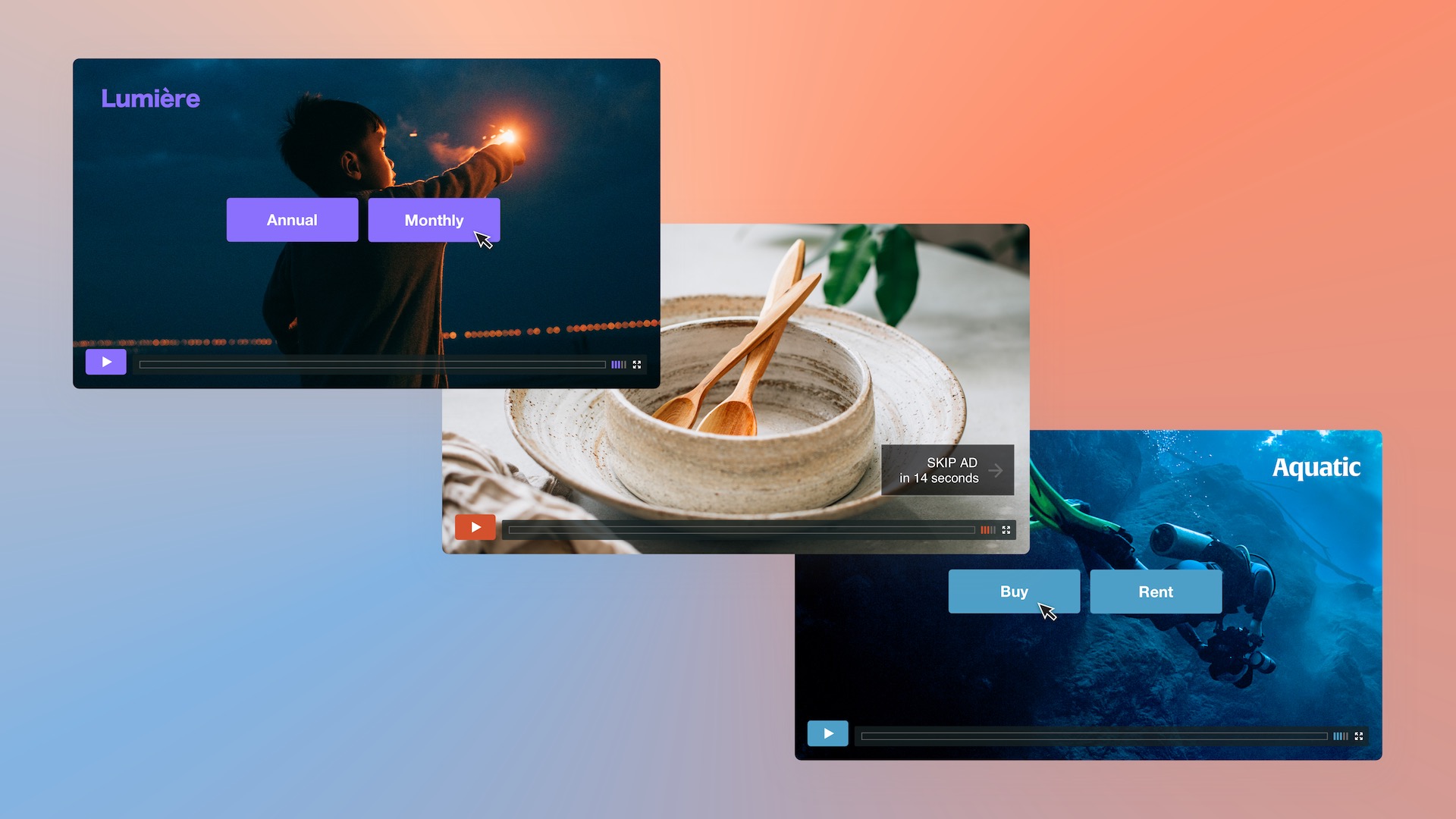

The explosive rise of video-on-demand (VOD) has revolutionized how content is delivered and monetized. Popular platforms like Netflix, Hulu, and Disney+ have made VOD the standard for how audiences expect to access video today: on their own time and across any device. These services use various models, such as subscriptions (SVOD), ads (AVOD), and transactional video on demand (like pay-per-view), to offer flexible viewing and monetization.
For aspiring content creators and established media enterprises, choosing the best VOD platform or vendor to host your videos is critical for maintaining control over distribution and maximizing revenue. In this article, we’ll break down how VOD works, explore its most common applications, and compare the top platforms for building and scaling a successful streaming service.
What’s VOD? Definition, benefits, and common uses
VOD refers to a content delivery model that allows viewers to watch video content at any time from any device without following a restricted broadcast schedule. It offers numerous benefits, such as flexibility, scalability, and monetization options for individuals and businesses alike.
While often used interchangeably, over-the-top (OTT) television and VOD aren’t the same — they refer to different parts of the streaming experience. OTT describes the method of delivering video over the internet without traditional cable or satellite providers. VOD refers to the ability to choose what to watch and when. In short, OTT is the delivery channel, and VOD is the viewing experience.
VOD isn’t the only way to watch videos online. Live streaming allows viewers to witness an event, like a news broadcast or gaming session, in real time. It’s commonly used to foster community and boost brand engagement, and to share information as quickly as possible. Linear streaming is an older form — if you grew up with cable or satellite TV, you’re likely familiar with it. This streaming option airs programs 24/7 at set times and on specific channels.
TVOD, AVOD, and SVOD platforms: Examples and common uses
Video on demand platforms typically fall under three primary monetization models, which can be blended into a hybrid form (known as HVOD). For example, Amazon uses both SVOD and TVOD, while Hulu combines SVOD and AVOD tiers. Here are some of the most well-known examples of each.
Transactional Video on Demand (TVOD)
Viewers pay per video, either to rent or purchase. Pay-per-view is one form of TVOD, where a user pays to watch a specific, often live, event with the payment typically covering a single viewing of the event. Some TVOD platforms are:
- Apple TV/iTunes: Rent or buy individual movies and shows.
- Amazon Prime Video: Pay-per-view options for new releases.
- Vimeo On Demand: Audiences can buy or rent content directly from creators.
Ad-Supported Video on Demand (AVOD)
Content is free to watch, with ads shown before or during playback. Some AVOD platforms are:
- YouTube: Most videos are free to view, supported by ads. However, you don’t get to choose which ads are paired with your content.
- Tubi: A free streaming service offering movies and shows with commercials.
- Pluto TV: Offers live and on-demand content with ad interruptions.
Subscription Video on Demand (SVOD)
Users pay a video-on-demand subscription for unlimited access to a content library. Some common SVOD platforms include:
- Netflix: Offers a combination of original content and familiar titles. Subscriptions cover an ad-supported paid tier and two ad-free tiers (standard and premium).
- Paramount+: Delivers live streaming and traditional content under ad-supported and ad-free tiers.
- Hulu: Provides both ad-supported and ad-free tiers, as well as bundles with other brands (from Disney+ to ESPN) and cable-like linear programming for additional fees.
On-demand video streaming: How does it work?
The details of uploading, hosting, and monetizing videos depend on your scale — a content creator uploading their latest video essay on a shared platform will have a very different experience than a large studio developing and broadcasting their content through a vendor. However, the process of on-demand video streaming generally includes a few major elements:
- Upload and storage: Video files are uploaded to a VOD platform, encoded, and stored in a secure network.
- Content delivery: When a user selects a video, the platform streams it at the local device’s resolution (based on its network connectivity) in real time.
- Access control and monetization: Creators can monetize their videos and manage viewer access by applying paywalls with TVOD, ads with AVOD, or subscription models with SVOD.
While many on-demand video platforms share this structure, they need to apply different measures of scalability and security for their customers. Content creators and broadcasters will need different features to reach their audiences, so a VOD platform that’s the right fit for a small team may not be for a growing enterprise.
Explore Vimeo Streaming for on-demand video →
The 11 best on-demand video platforms
Navigating the vast landscape of on-demand video platforms to find the right fit for your content and audience can be challenging.
Below are some of the top platforms and hosting solutions for those looking to launch or expand their VOD streaming service. Each offers a unique mix of features, pricing models, and customization tools to help you manage and monetize your content effectively.
1. Vimeo
If you’re a creator or niche media company with a loyal fanbase, Vimeo Streaming offers a full suite of tools to launch your own video-on-demand streaming service.
Vimeo stands out thanks to its customization options, giving you complete freedom over your video monetization strategy. With Vimeo Streaming, you can set up your own custom streaming service, where you can charge for videos on demand, run advertisements, build a mobile or TV app, or create your own channel to build a community of paid subscribers. It’s an all-in-one solution that helps you launch a site and apps within your branding guidelines for a consistent viewing experience, with the intuitiveness and ease of Vimeo’s UI.
Main features include:
- Vimeo offers SVOD services for branding, sponsorship campaigns, and event promotion (as well as merchandising and additional content), increasing monetization opportunities.
- As for AVOD, Vimeo gives you full control of your branding without the unwelcome ads YouTube can play.
- Deep insights into your content, your audience, and your business, thanks to the partnership with top analytics platform NPAW. These insights unveil trends on how your content is performing, profile your audience and their viewing habits down to viewer level, and analyze key business metrics, offering key information to improve your business strategy.
- Integration with popular website builders, like WordPress, Wix, and GoDaddy, and other third-party programs, from social media to customer relationship management (CRM) software, for strong cross-platform collaboration.
- End-user support so you can focus on what matters the most to you and your content, and let Vimeo directly answer questions from your viewers.
- Custom-branded app kits for visual consistency across every touchpoint, tool, and page.
- Top-of-the-line security certifications, including ISO 27001 and 27701 certifications, SOC 2 Type II and SOC 3 reports, and EU DPF certification.
- Wide range of privacy and user security features, such as digital rights management, data retention controls, encrypted storage, and more.
With branded apps, built-in monetization tools and actionable analytics, and end-user support, Vimeo Streaming combines the simplicity large creators want with the scalability media companies need.
If you are a smaller creator or a smaller media company that doesn’t want to create its own branded video platform, Vimeo On Demand could help you reach the widest audience possible. Vimeo On Demand lets you sell your work directly to audiences. If you’re a Vimeo Standard member or above, you can sell your films and series the way you want with all the power of Vimeo’s HD video player, easy-to-use tools, and access to Vimeo’s discerning audiences.
But as your audience grows and your attention shifts to strengthening relationships with them, consider Vimeo OTT for more refined streaming needs across a variety of consumer devices with your own and operated apps.
Start your own streaming channel →
2. YouTube
To monetize YouTube videos, you’ll need to join the YouTube Partner Program, which uses Google AdSense to run advertisements on your videos. While you could technically monetize your YouTube channel with sponsorships or affiliate marketing instead of AdSense, you’d be leaving money on the table.
YouTube monetization is strictly regulated according to its community guidelines and content policies. Any conflicts with those policies could result in your videos or entire YouTube channel getting demonetized. To monetize on YouTube successfully, you must remember these guidelines whenever you create content and check your YouTube Studio account notifications regularly for messages about infractions.
Compare YouTube and Vimeo →
3. Patreon
Building a membership community on Patreon lets you engage with your audience directly. You can add a low monthly donation option, gate access to certain subscriber levels, and even offer personalized content to subscribers at the highest tier.
Nurturing a community this way works best if you have a particular niche. If no one else is making your type of content, your fans will know that your Patreon is worth the entry price. That way, you can monetize the products you’re creating, as well as videos that showcase your process. However, you’ll need additional software for editing videos, drafting scripts, and measuring engagement, as Patreon is only a monetization and community-building tool.
4. Uscreen
Uscreen is a popular VOD solution for fitness coaches, educators, and influencers. It supports SVOD and TVOD models, community tools, and custom-branded OTT apps. Uscreen offers community features, such as live chat and discussions, to enhance viewer engagement, while its analytics tools give creators insight into subscriber behavior and growth.
Its main features include:
- Custom-branded OTT apps for web, mobile, and smart TVs
- Monetization via SVOD and TVOD
- Analytics that combine engagement, revenue, and subscriber data, with filtering and drill-down and external API access
- Community-building features like live chats and discussions, including post creation commenting, media sharing, and notifications.
- Security features like geoblocking to restrict content from countries or individuals, IP and concurrent session limits, and device session limits to avoid spam and maximize paid usership
Uscreen’s flexibility and community-focused tools make it a great option for solo-preneurs, small practitioners, and content creators seeking to forge a strong connection with their audience.
5. Kaltura
Kaltura is an enterprise-grade VOD solution tailored for businesses and educational institutions that offers powerful internal communications features, training, and LMS integrations. The video solution platform’s extensive API access provides flexibility for customization, including third-party monetization tools for scalable revenue generation.
Kaltura’s complex interface and pricing structure may be overwhelming for small businesses or individual creators. It’s best suited for large enterprises that need robust video management and distribution tools.
Main features include:
- Extensive API and SDK for integration and customization
- Advanced LMS integrations for educational institutions
- Multiple monetization options, including subscription-based and transactional models
- Video hosting and live streaming with high scalability — no limits on number of viewers
- Flexible API that lets users pick the best balance of security and flexibility for their needs
Kaltura is ideal for larger organizations that require a flexible, enterprise-level solution that gives them full control over their video workflows.
Compare Vimeo and Kaltura →
6. Dacast
Dacast is a highly flexible VOD hosting platform that supports both live streaming and on-demand video hosting. With monetization options like SVOD and TVOD, Dacast makes it easy to create and monetize your video content. Its white-label branding feature allows businesses to customize their players and deliver a unique viewer experience.
More advanced features, such as paywalls and analytics, only come with higher-tier paid plans. Dacast’s streamlined interface and multi-content delivery network (CDN) streaming make it a good choice for both startups and established businesses.
Main features include:
- White-label branding for media companies
- Flexible monetization options, including SVOD and TVOD/AVOD hybrids
- High-quality video delivery with low latency
- Aggregated analytics for tracking video performance
Dacast’s combination of live streaming and VOD hosting makes it a versatile option for businesses looking to engage viewers and monetize their content.
Compare Vimeo and Dacast →
7. Muvi
Muvi is an end-to-end solution offering built-in OTT apps and content management tools. It supports all monetization models, including AVOD, SVOD, and TVOD, but Muvi’s pricing can be steep, especially for independent creators. This makes it more suitable for larger businesses and media networks.
Main features include:
- Built-in OTT apps for iOS, Android, Roku, and more
- Monetization through AVOD, SVOD, and TVOD
- Customizable CMS for managing video content
- Live streaming with high scalability with flexible options for over 1 million users
- Additional podcast hosting platform for distributing, managing, and monetizing audio-only VOD content
Muvi’s all-in-one capabilities and sophisticated customization options make it a contender for media companies and businesses looking to scale their streaming operations, especially those working with multiple content types.
8. Wowza
Wowza is designed for developers and enterprise teams that need custom streaming infrastructure. Its extensive API access and custom infrastructure options allow for deep integration into any workflow. While Wowza claims to specialize in ultra-low latency video delivery, its CDN and HTML-5 video players aren’t as robust as the other VOD platform creators we’ve mentioned, so it won’t scale as well for larger audiences.
Pricing is based on usage, so it may not be the most cost-effective solution for smaller creators or businesses with modest streaming needs.
Main features include:
- Ultra-low latency video streaming for live and on-demand content
- Customizable infrastructure with API access for integration
- Scalable hosting for large-scale streaming services
- Advanced security features, including encryption and DRM
Wowza’s enterprise-level streaming capabilities make it a great choice for large businesses and developers building custom streaming solutions.
9. Castr
Castr is primarily a streaming platform, letting users stream simultaneously on up to 30 platforms, but also offers video hosting with monetization capabilities. It offers a television-like experience for live stream viewers, as they can upload pre-recorded videos that are shown in real time on a set broadcasting schedule through embeddable web players. More advanced features, such as paywalls and analytics, are available at higher pricing tiers.
Main features include:
- Multi-platform streaming to over 30 popular platforms like YouTube and Vimeo
- Monetization through ads, subscriptions, and pay-per-view
- Set broadcasting schedule (once, weekly, or continuously looping) of pre-recorded streaming material
- Privacy and security features like geoblocking, password protection, and domain referrer protection
Castr’s compelling blend of affordability and flexibility makes it a strong choice for creators looking for an entry-level VOD solution with room to grow.
10. VPlayed
VPlayed is a white-label VOD platform that allows businesses to create their own branded streaming service. It supports all major monetization methods, including SVOD, AVOD, and TVOD, and includes security features like DRM to protect content. While it’s highly customizable, VPlayed is geared more toward larger media organizations and enterprises than individual creators.
Main features include:
- Customizable white-label streaming platform
- Multiple monetization models, including AVOD, SVOD, and TVOD
- Security features like DRM for content protection
- One-time payment model for lower creation costs
VPlayed is ideal for businesses looking to build a branded streaming service fortified with advanced security and customization options.
11. Brightcove
Brightcove is a video streaming service that focuses on live streaming and highly customized corporate video sharing. It’s backed with sales-like user analytics that look at a range of engagement metrics for every video and channels as a whole. However, it’s only built at the enterprise level, so Brightcove isn’t a good fit for small creators (or even small media companies).
Main features include:
- Offers AVOD and hybrid monetization models
- Server-side ad insertion for smooth ad playback, even with ad blockers
- Security features like ISO 27001 certification, role-based access control, and DRM
- Context-aware encoding for better video playback at lower bandwidths (and costs)
Ultimately, Brightcove is an expensive option for big brands that want to create customized marketing videos and grow their audience by studying analytics.
Compare Brightcove and Vimeo →
How to choose the perfect VOD platform provider for your business
When comparing VOD platform providers, start by considering the following factors:
- Your target audience: Who are you trying to reach, and where do they watch?
- Type of content: Will you share lectures, entertainment, internal training, or all of the above?
- Monetization models: Will you use TVOD, SVOD, AVOD, or a hybrid approach?
- Privacy and security: Do you need watermarking, DRM, or password protection?
- Scalability: How will the platform continue providing high-quality streaming as your audience grows?
- Streaming quality and compatibility: Can your provider deliver fast, buffer-free playback across all devices?
Evaluating your needs across these factors can help you choose the best VOD platform to reach your business goals.
Host, stream, and monetize your content with Vimeo
From education and entertainment to enterprise presentations and employee training, today’s VOD apps support a range of formats, streaming services, and revenue strategies. And as the demand for flexible, on-demand video content continues its upward trajectory, selecting the right VOD platform is paramount for scaling your content.
With Vimeo on Demand and Vimeo Streaming, creators and businesses can easily launch their own professional-grade VOD services. Vimeo helps users monetize their content, grow their audience, gain insights into revenue and subscriber growth trends, and easily manage and expand their video content.
Launch your streaming service with Vimeo and turn your video library into a revenue-generating opportunity.